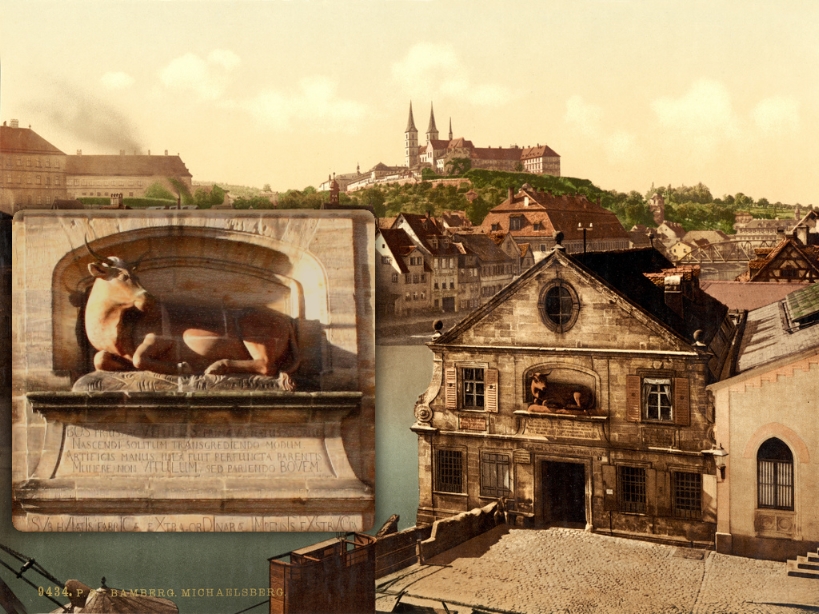
“An ox that was never a calf”
The Baroque slaughterhouse on the riverbank, standing near where Kapuzinerstrasse begins, was built in 1742. From 1863 a market hall for the sale of meat adjoined it. This had to make way for a new building, a university faculty library, in 1984. The slaughterhouse was built into the water on five pillared arcades, so that water flowed through the west side of the one-storeyed building. Thus meat waste could be disposed of easily. Above the front entrance, facing the Kranen square, lies an ox hewn in stone, the work of Johann Adam Nikol, with a Latin inscription. It translates “To be born an ox at once and not first a calf is against nature… the hand of artifis as parent brought forth not a calf but an ox”
Read more: http://blog.travelpod.com/travel-photo/jaq123/3/1310320567/4_bamberg.jpg/tpod.html#ixzz1arVAKQpe
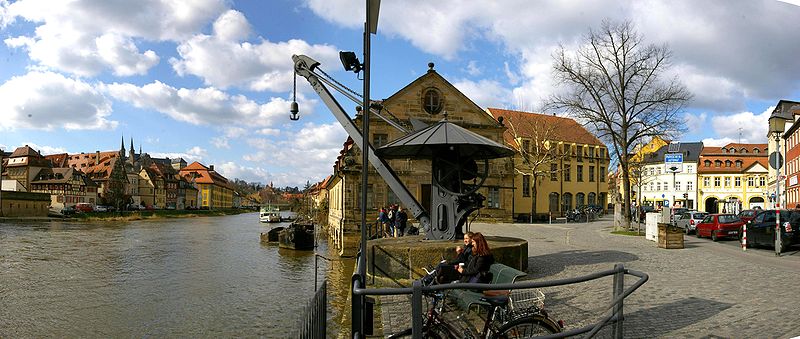
The little square “Am Kranen”, alongside the left arm of the Regnitz and just below the Town Hall Bridge, was harbour and fish market from the 14th century. It lay outside the first city fortifications at that time. When these were extended as far as today’s Kleberstrasse in the 15th century, the square was integrated into the island town. Here, at the beginning and end point of waterway traffic on the Main, the boatmen earned considerable money trading to the Rhine. Steps led down into the water from the high quayside wall, so that the boatmen could easily unload at different water levels. A crane was needed and this gave the square its name “Am Kranen” (by the crane). Historical pictures show the early technology that was used, with a rotation axis and treadwheel. To protect the mechanical parts, mainly of wood, the whole crane was enclosed with a half-timbered construction. The two cast-iron cranes, that now stand on the quayside, were erected in connection with the Ludwig Canal in 1849 and 1864. They marked the temporary end of the man-made waterway, which linked Danube and Rhine. The Bamberg harbour was situated here until 1912, when the Prince Ludwig Harbour, constructed in the north part of the city, took over its function. Today vessels tie up at the quay to take tourists and visitors to see Bamberg from the water. Opposite is “Leinritt”, the towpath along which barges were pulled upriver by teams of horses with long ropes.
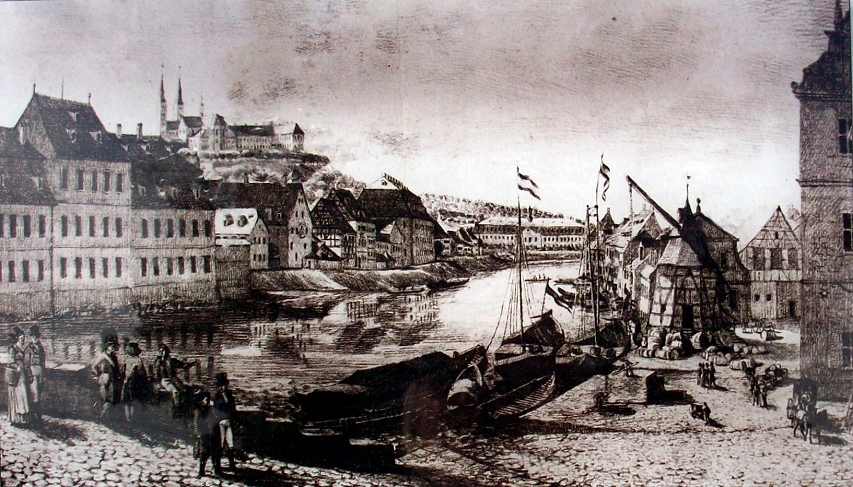
Alter Hafen 1820 von Eugen Napoleon Neureuther (Historisches Museum Bamberg Inv. Nr. F87)