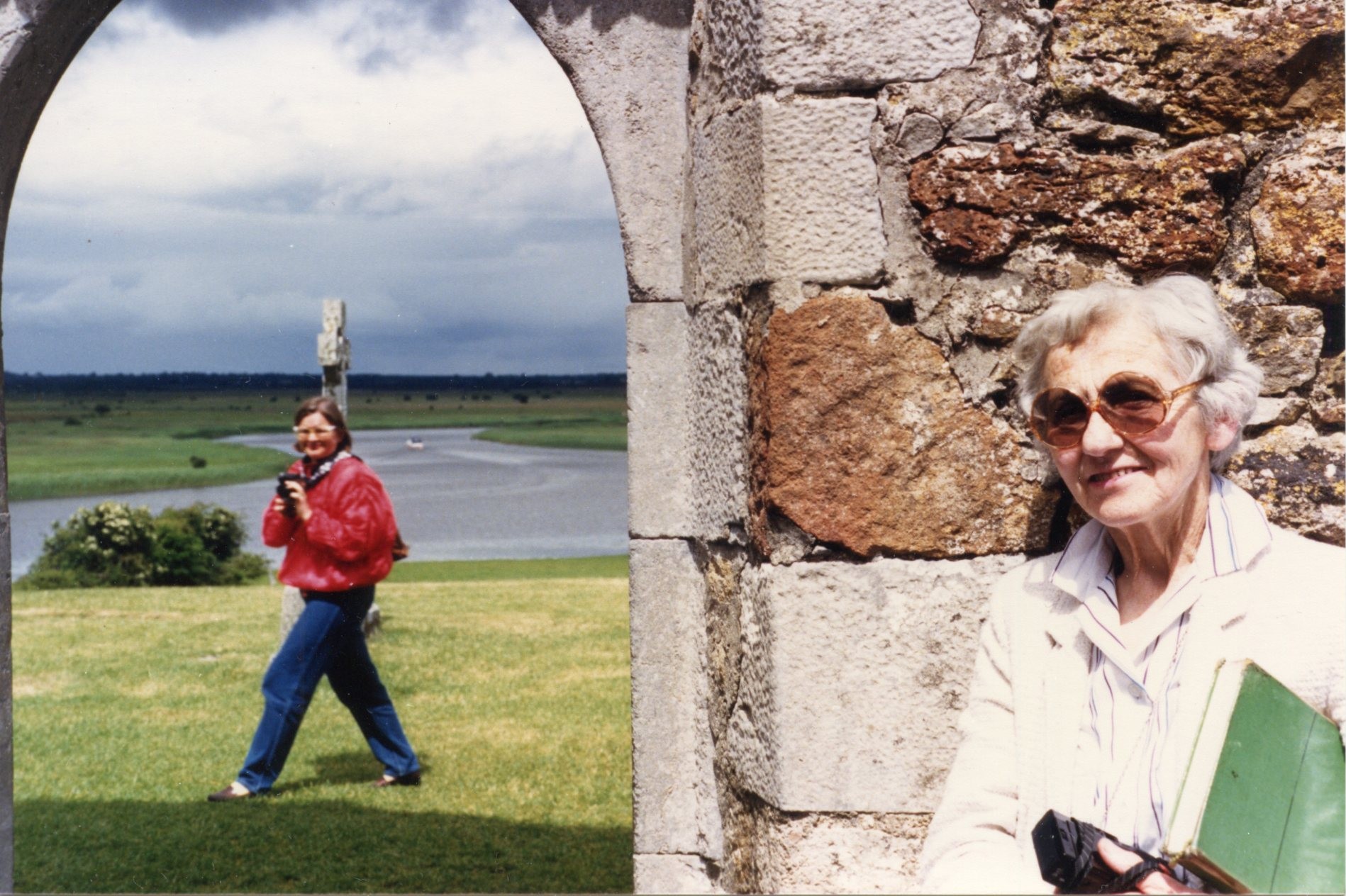
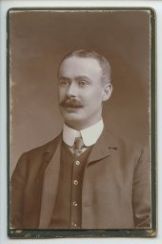
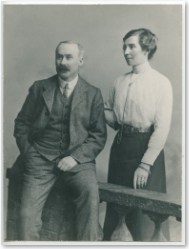
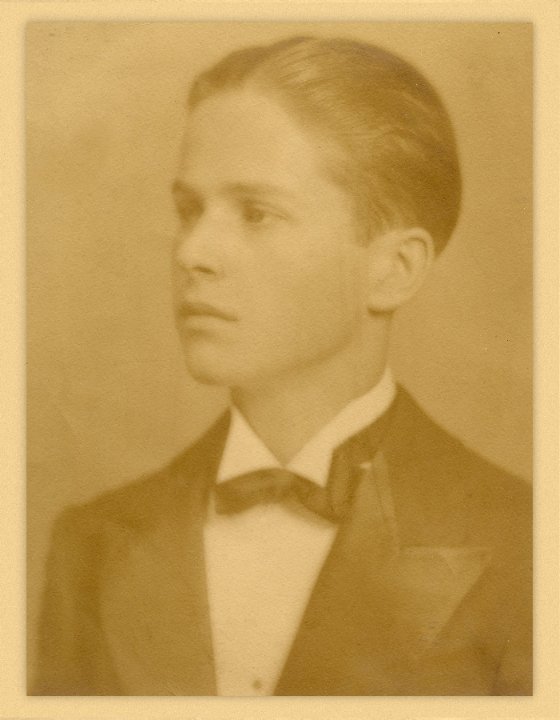
An ornate frame containing a photograph of my Grandfather, John McCauley came to me from my late aunt, Eileen McCauley.
It contains a small cabinet card portrait, about 2 1/2 inches wide by about 4 inches tall (about 6.5 cm x 10 cm) - a
photograph of my grandfather, John McCauley, who was a customs and excise officer in the civil service.
I took out the card from it's frame and scanned it at high resolution. I processed the scanned image, removing
the blemishes, scratches and dots in the body of the picture, while attempting to keep the qualities of an old
photograph.
John and his sister Letitia, were both born in Balaghadereen in the 1870s, at the time in the county of
Mayo, now in Roscommon, since a transfer in 1898 (see John's baptism record below). His
parents - my Great Grandparents were James and Eliza McCauley.
John was born on 6th May 1871 and died in Jervis Street hospital in Dublin on 26th March 1926.
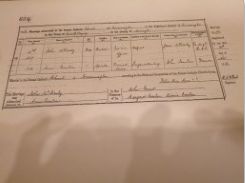
In Crossmaglen on 12th November 1912, he married Anne Conlon, at the time, a nurse at the Union Hospital,
Belfast.
John's work took him far afield. In 1912, his base remained in Port Arlington and, in December 1913, their
first born, Margaret Elizabeth, likely named after John's mother, Eliza, was born in the nearby suburb of
Kilmalogue.
Tragically after only four weeks, on January 13th 1914, Margaret died from 'convulsions' often
now diagnosed as epilepsy or described as a cot death. John's Civil Service record says that in January 1914,
he had been successful in his exam for Surveyorship with increased salary, but he was not listed as a Surveyor in Dundalk
until January 1919.
Later in 1914, the young McCauley family were living in Annie's Conlon homestead in Lurgancullenboy ‐
7 Lurgan Road, and it was there on 28th November 1914 that their first son, John Patrick (Jack)
, was born.
Then, between 1914 and 16, they moved house to the
Crescent in Haggardstown, Blackrock, Dundalk where James (1916),
Frank (my father, 1918), Maura (1919) and Olive (1920) were born.
Teresa McCauley (15th October 1922 to 27th October 1922) was the last child born in the Crescent, who sadly died
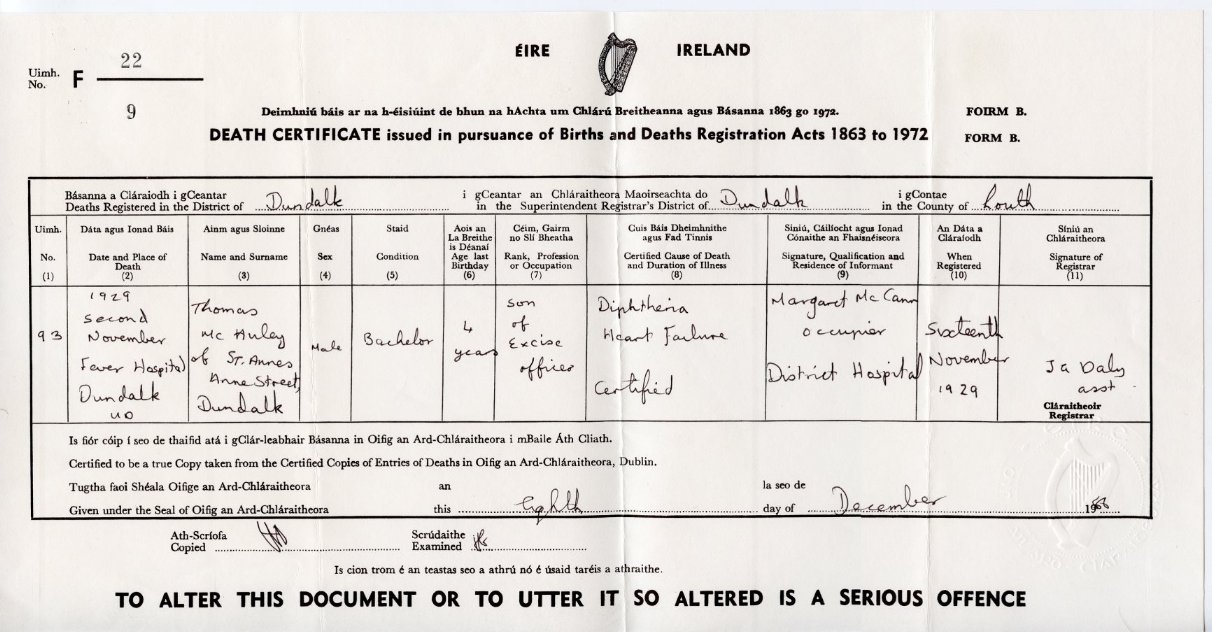
after only twelve days from Spina Bifida. John and Annie's last child, Thomas Desmond McCauley
(28th December 1924 to 2nd November 1929) was born in St Anne's House in Anne Street, Dundalk Town,
tragically, at four years old, dying from Diphtheria.
There are very few photographs in my posession of my grandfather on my father's side of the family and they are all
included here. No letters or other personal papers for John, Annie or his sister Letitia, that I
know of, survive. I suppose it may have been a family convention to dispose of everything of the deceased, or maybe
they just didn't keep any papers when they were alive. As John's wife Annie, my
grandmother, 'Granny Mac' lived until 1956, there are a few photographs, thank goodness, which
I have included, many from my parent's wedding in 1947.
Please download the enlargement if you wish, by first clicking on the document picture and then use 'right-click'
and 'save as' on the fullsize image. All are large files and so might take a while to download. All
the documents and photographs can be downloaded in the same way.
Cabinet card back
4.03 MB (4,231,168 bytes) 2151 x 3235 pixels 800 dots per inch
Cabinet card front - original scan
3.57 MB (3,751,936 bytes) 2151 x 3235 pixels 800 dots per inch
Cabinet card front - cleared of debris
PLEASE use this version if you would like to make a print.
4.21 MB(4,419,584 bytes) 2151x3125 pixels 800 dots per inch
136 KB (139,264 bytes) 1540 x 599 pixels 96 dots per inch
Birth Certificate
280 KB (286,720 bytes) 1738 x 944 pixels 240 dots per inch
Church Record of Baptism for John McCauley
Catholic Parish Registers Diocese Achonry, Castlemore and Kilcolman.
Eliza Quinn, Spouse James McCauley, Child John McCauley, 10th May 1871 - (born 6th May 1871.)
In 1860, Ballaghaderreen Cathedral was dedicated as the cathedral for the Roman Catholic Diocese of
Achonry. Ballaghadereen is part of the Barony of Costello and in the parish of
Kilcoleman.
Prior to 1898 the town and parish of Ballaghaderreen and Edmonstown was located in the eastern part of County Mayo until its
transfer to County Roscommon under the Local Government Act 1898 by the Parliament of the United Kingdom. This has
led to some anomalies, for example the local Gaelic Athletic Association team, Ballaghaderreen GAA plays in the Mayo
championship and its players represent County Mayo.
544 KB (557,056 bytes) 1332 x 839 pixels 72 dots per inch
1.54 MB (1,622,016 bytes) 2592 x 1944 pixels 72 dots per inch
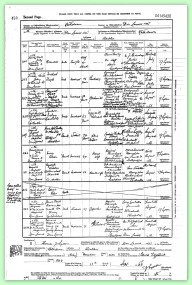
John McCauley - 1926 - Deaths registered in the District of Dublin.
Registrar's District N.City 2
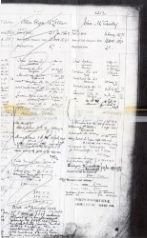
John passed away in Jervis Street
Hospital, Dublin RIP. The registration was difficult to find as, not only did the entry erroneously read
'James' but the surname was also wrong - 'McAuley', the former corrected in the margin by the
registrar.
Please click to expand:
Tragic for the bereaved with many infant and young adult deaths in the entries here, God rest their souls. Our John
being the oldest on this page at just 55.
480 KB (491,520 bytes) 1325 x 1690 pixels 300 dots per inch
Gravestone Memorial
Castletown Cemetery, Dundalk, Louth (photograph taken on location by John McCauley in 2014).
Please click to expand:
2.32 MB (2,441,216 bytes) 1944 x 2572 pixels 72 dots per inch
Customs and Excise career- copy of the Hamms Register from
London
John was married in 1912 and by 1915 he was listed as an Unattached Surveyor for the Chief Inspectors Office.
Although he would have had to visit Dublin often, London less so, he could have been posted anywhere during the time of
the Easter Rising in 1916. John's allocation to Port Arlington remained after marriage when Annie began the family
back home in Lurgencullenboy in Armagh, moving afterwards to Blackrock, Louth, then Anne Street Dundalk.
1.85 MB (1,949,696 bytes) 2213 x 3702 pixels 100 dots per inch
184 KB (188,416 bytes) 987 x 1360 pixels 240 dots per inch.
John was appointed an acting District Surveyor in 1921 with a weekly expenses allowance (mostly for travel) of 70 shillings.
The surveyor would have supervised the day-to-day work in Enniskillen, Newry, Clones and Drogheda particularly.
Census of Ireland 1901
Name: John McAuley
Gender: Male
Marital status: Single
Age: 30
Birth Date: abt 1871
Birth Place: Co Mayo
Residence Date: 31 Mar 1901
House Number: 4*
Residence Place: Altamont Street, Westport Urban, Mayo, Ireland
Relation to Head: Lodger
Occupation: Excise Officer
Religion: R C
Literacy: Read and write
Household Members:
Clara Landers 60
Kate Swifte 22
It's shown in John McCauley's Customs and Excise career records that, in 1901, at 30, he was working in Westport in
County Mayo. Indeed, the 1901 Census record gives his address there as house number 4 in Altimont
Street.
*Of course, this may not be the actual Number 4 in the street, as the enumerators often used an arbitrary numbering for
listing the dwellings in a street or townland.
In 1901 John is listed as a lodger and the house was home also to two ladies, Clara Landers ('head of family') and a
22 year old servant, Kate Swift.
If the enumerator started at the northern end of Altamont Street (previously Altamount St.), I feel that it's likely to
be one of these houses in the photographs here.
Please click to expand.
Census of Ireland 1911
Name: John McCauley
Gender: Male
Marital status: Single
Age: 39
Birth Year: abt 1872
Birth Place: Mayo
Residence Date: 2 Apr 1911
House Number: 28.1
Townland/Street: Duncairn Gardens
District: Duncairn
County: Antrim
Country: Ireland
Electoral District: Duncairn
Literacy: Read and write
Occupation: Officer ICL Customers Excise
Religion: Roman Catholic
Relationship: Boarder
Unlike the numbers in the 1901 Census, there's no speculation about John McCauley's residence in 1911 because it is
specified on the Family Return Form A. John's employment in Customs and Excise indicates that he was stationed in
Belfast 14 from 1910 until a further move to a Kilarney office in Limerick on 1st April 1912. As he was married in
November 1912, it seems likely that he met Annie Conlon who was working in the Union Hospital during the time he was in
Belfast; from 1907 to 1912. Although a Christmas card from Annie in 1911 mentions the Union Hospital, I was perhaps
mistakenly told that she worked at the Mater Hospital in Belfast.
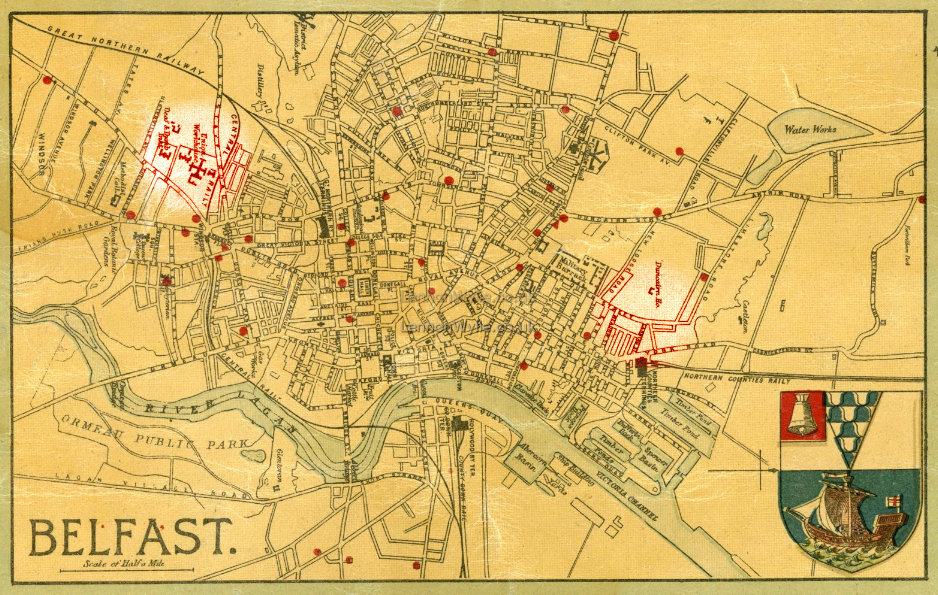
In 1911 John was living in the Parish of Shankhill in East Belfast, at 231 Duncairn Gardens. Many buildings in the
area, including 231, were levelled in the second world war and new flats built on the site on each side of the road.
I've included a photograph of neighbouring buildings to show what 231 might have looked like when John lived
there.
Please click to expand.
The area between the New Lodge Road and Duncairn Gardens was historically occupied by the better‐off working‐
class families, while Duncairn Gardens itself and Clifton Street were upmarket well into the 20th century.
Victoria Barracks, a major British army barracks, was an important feature of the area.
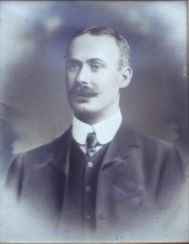
Portrait of John McCauley - hanging in the salon of Neville Road
(This looks very much like the same photograph as the cabinet card.) These are from kodachrome slides of the
portraits, snapped by me on a visit to Dublin with my father in the 1970s.
The studio also produced a tinted portrait of John's wife Annie, which hung alongside John's
picture.
2.22 MB (2,334,720 bytes) 3717 x 4817 pixels 72 dots per inch
Studio Photograph - probably taken for their wedding in 1912.
4.01 MB (4,214,784 bytes) 4915 x 6517 pixels 800 dots per inch
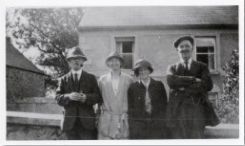
1925 ‐ 7, Lurgan Road, Lurgancullenboy
is written on the back but this looks
to me like the Conlon house near Silverbridge; Mullaghbawn.
Left to Right, John McCauley, Annie McCauley (Granny Mac), Rose Conlon, ‘Uncle’ Pat Conlon (a
police detective).
1.92 MB (2,019,328 bytes) 2486 x 1536 pixels 96 dots per inch
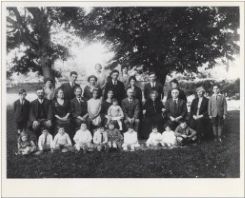
Visitors from America
The Paddock, Mrs Ferguson's House, Blackrock, Dundalk. A short walk south of The Crescent in Haggardstown.
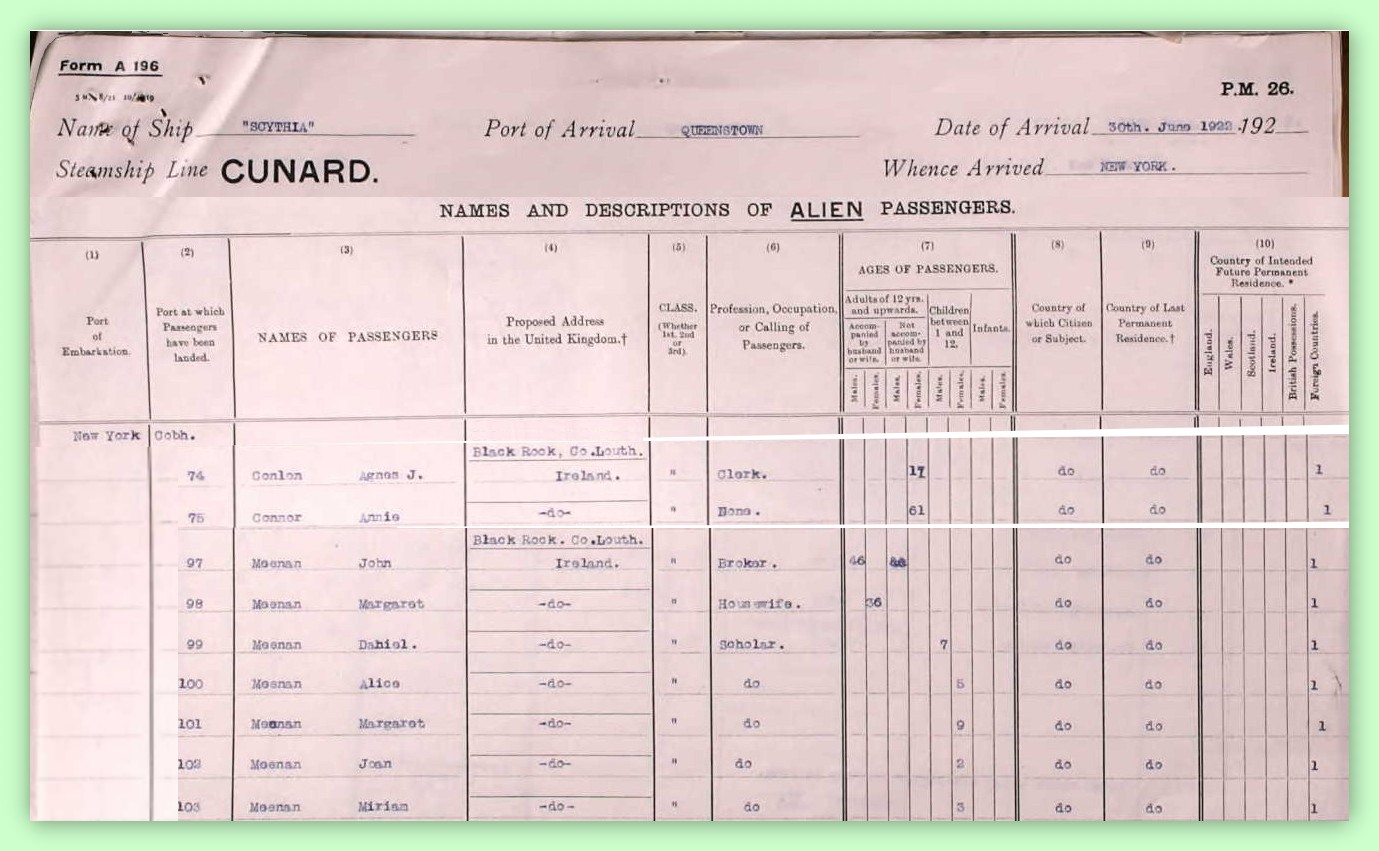
Arriving in the new provisional Irish Free State and Dun Laoghaire from New York on Friday 30th June 1922, the picture must have been taken between July and September; can't
see many leaves on the lawn so more likely to have been in July, maybe the 12th (or Thursday 13th) as that's the
date of Annie's birthday. The visitors set sail from Liverpool to New York on 14th September 1922.
1.97 MB (2,068,480 bytes) 3570 x 2888 pixels 96 dots per inch
Visitors from America - who's who.
Between July and September 1922. The Paddock, Mrs Ferguson's House, Blackrock, Dundalk.
John and Annie's nephew standing on the left is Malachy Conlon MP. I was named after him, since my father was very fond of his cousin. My dad,
along with other contributors helped identify all of the people in the group photograph.
Standing on the opposite side to Malachy, next to his father John and Annie McCauley, is Daniel Meenan..
96.0 KB (98,304 bytes) 1138 x 821 pixels 100 dots per inch
Please click to expand.
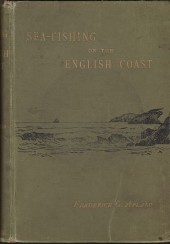
Sea Fishing on the English Coast - by Frederick Aflalo
‐ signed on the inside cover by John McCauley and dated 25th November 1916. Can't make out the name of the
fishing club he belonged to.
8.25 MB (8,650,752 bytes) 8370 x 5951 pixels 100 dots per inch
John's Notebook
Some pages from the notebook of John McCauley. In here he kept a tally of his business and household spending.
Photographs from John's grandson namesake John McCauley.
There's a note for expenses for a trip to London in January 1916, on one of the pages. The Easter Rising at home
and the horrors of World War 1 underway ‐ there's a story about John seeing the Thames frozen over and people
skating on it. Not that unusual prior to climate change; gaia cycle ‐ it last froze over in my lifetime ‐
1963. For work duty John travelled to the UK mainland relatively frequently and worked in Scotland and England ‐
evidenced on his career record. There's a note for Killala in 1919 ‐ the year mother
Eliza (nee Quinn) died.
John's Bankbook
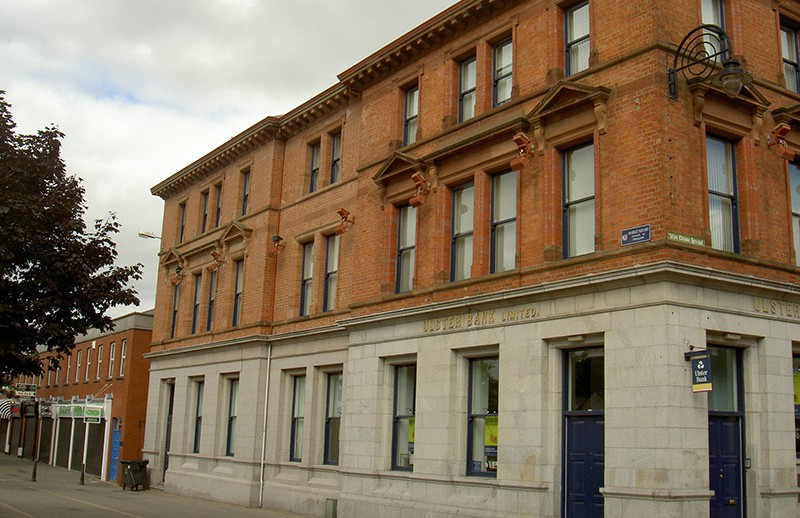
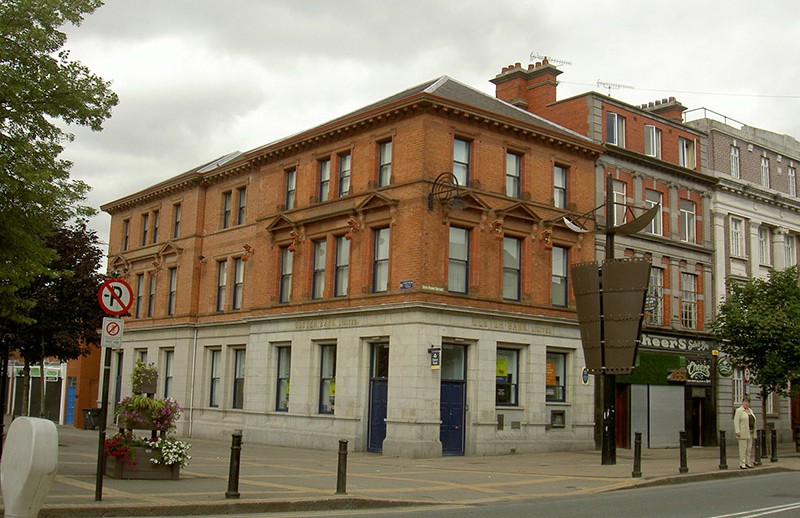
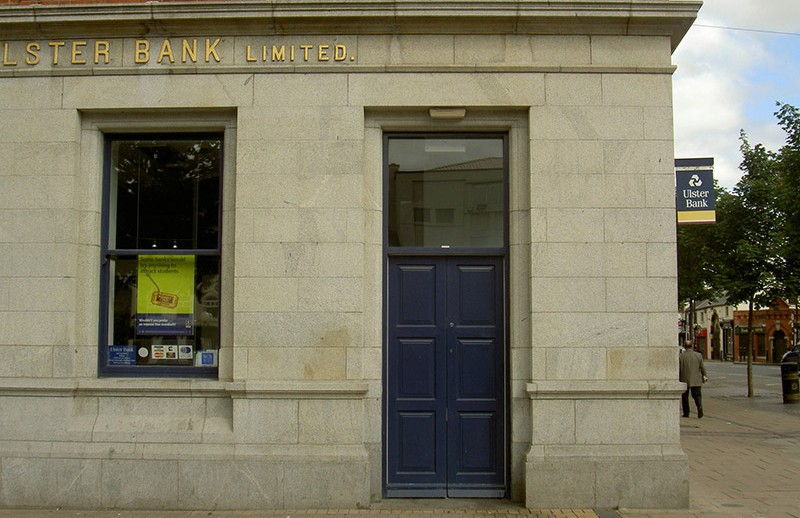
A few pages from a bankbook of John McCauley. The Dundalk branch of Ulster Bank Limited. An account opened in
1917 with pages up to 1927, entries no doubt maintained by Anne McCauley the year after John died.
Corner-sited attached three-bay three-storey red brick and stone bank, built c. 1890.
Extended to west. Hipped slate roof, leaded ridge and hips, projecting eaves with ashlar sandstone soffit on
carved brackets to sandstone fascia, moulded cast‐iron gutters. Red brick walling laid in Flemish bond,
sandstone banding and continuous sill courses; ashlar granite walling to ground floor, projecting plinth, carved stone
cornice and string courses, lettering reading "ULSTER BANK LIMITED".
Square-headed window openings, paired windows to south elevation, sandstone pediments supported on carved brackets to
first floor, ashlar fascia, brick surrounds, roll-moulded soffits and reveals, painted timber one‐over‐one
sliding sash windows; sandstone canopy to central paired window south elevation supported on carved brackets;
lugged and kneed surrounds to second floor; windows set in square-headed recesses to ground floor with splayed
sills. Square‐headed door openings to south and east elevations in square‐headed recesses, roll
‐moulded soffits and reveals, painted timber panelled double doors, plain‐glazed overlights. Sign on
east elevation reads "Site of Warren's Gate 13‐14th Century defensive Town Gate". Street
fronted, pedestrianised square to south.
Corner‐sited along an important thoroughfare within Dundalk, this fine building forms a landmark within the town.
Designed by Vincent Craig, the contrasting use of red brick and sandstone with granite makes for an appealing structure.
Quality craftsmanship is displayed throughout with skillfully executed window surrounds and an obvious attention to
detail.
Annie McCauley
My grandparents John McCauley and Anne Conlon were married in Crossmaglen on 12th
November 1912. As can be deduced from John's personel record along with the information in the
1911 census, they most likely met when they were both working in Belfast; he in the Customs and Excise
service, there, on request since 1907, and she as a hospital nurse. On her Christmas greeting card to John she's
written 'Union Hospital'.
On the marriage certificate in 1912, Anne's address is Lurgancullenboy in Armagh. It's likely that she stayed
in the Hospital Nurses accommodation, commuting home about 30 miles away, whenever duty allowed.
Anne Conlon was born in Lurgancullenboy in County Armagh on 12th of July 1882. Last but one of ten children, her
father John died young, at age 60, her parents John and Margaret married in the 1860s. Annie was, in 1901, a
scholar monitress and ten years later a nurse in Belfast, where it's likely she met my grandfather John.
Once again with the family, there are no letters or personal papers to give us all a better idea about her good self.
It's possible that she started training or qualified as a nurse in 1903, as a birth certificate copy was issued on the 11th
of August in that year.
The family, including John's brother Letitia, moved to Neville Road from St. Anne's house, Dundalk at the latest
around 1934 which is when Annie's name is dated on a list of owners researched in the National Library by my cousin
Geraldine McNally.
At the age of 74 she passed away in St Michael's hospital in Dun Laoghaire, Rathdown on 2nd June 1956. Sadly for
me, I can't remember her very well as I was only about four when the family went on holiday from London in 1955 and
visited our relatives in Dublin. Happily there are photographs of this event, which are included below.
Over the later years of his life, my father often expressed his devotion and great affection for my grandmother and without
going into great detail, related the trials that she had to endure, bringing the family up, having lost her husband John,
who had passed away at only 55.
Bridget, Patrick and John Conlon are listed in the Griffiths Valuation from the 1860s as being tenant
farmers in the adjacent townland of Mounthill, a stone's throw from Lurgancullenboy. In the 1980s and 90s I made
a series of charts for the Conlon genealogies, having a good starting basis thanks to the information supplied by my uncle
Jim.
Looking back to the generation prior to that of Annie's; to the early to mid 19th century, Annie's aunt Margaret
Conlon married Francis Short which lead to a considerable progeny including not only the actor Martin Short but also the MP
Clare Short, whose father Francis, who lived in Battersea, was acquainted with mine in London as they were both members
of the Irish Club.
Visiting Lurgancullenboy on a tour with my Aunt Olive in the late 1960s, we stopped and were met by a very elderly lady
known to Olive, who, after a chat, explained that she'd once met my mother and that her surname was Conlon but neither
she nor Olive were able to tell me just how she was related!
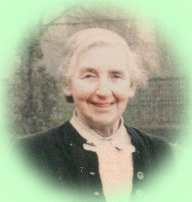
A Portrait of Anne McCauley
'Granny Mac' from Neville Road 1912. This is the partner image of John's from a
kodachrome slide snapped by me on a trip to Dublin in March 1974. A good example of the artistry of the photographic
studios in Edwardian times, the producers of large skilfully tinted portraits.
2.54 MB (2,666,496 bytes) 4011 x 5111 pixels 96 dots per inch
Birth Certificate of Annie Conlon.
There's a story that the family managed somehow to change the date to the 13th of July from the 12th July (the 12th
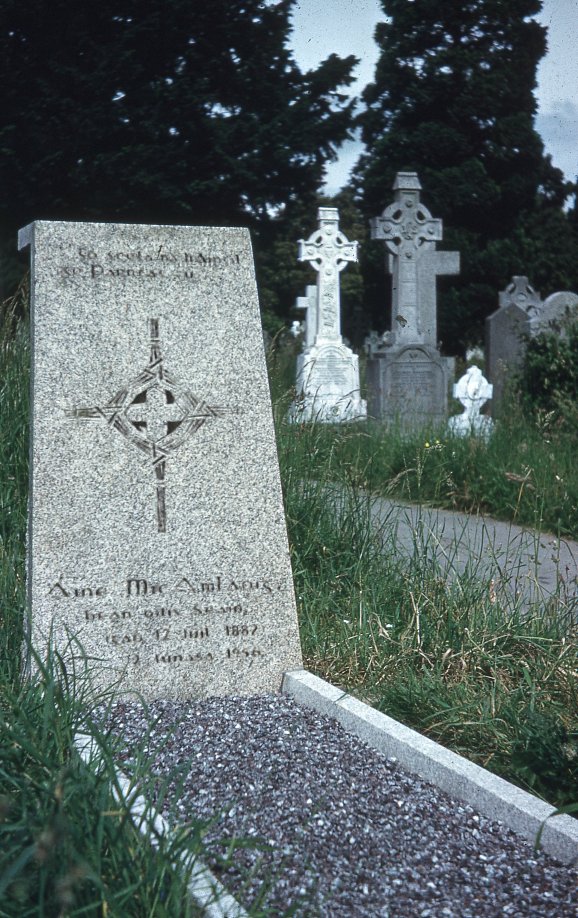
being Orangeman's Day). The 12th of July is shown on the memorial in the cemetery. I share the same
birthday.
288 KB (294,912 bytes) 1726 x 944 pixels 240 dots per inch
Census of Ireland 1901
Name: Annie Conlon
Religion: Roman Catholic
Literacy: Read and write
Household Members: Name, Age
Gender: Female
Marital status: Single
Age: 18
Birth Date: abt 1883
Birth Place: Co Armagh
Residence Date: 31 Mar 1901
House Number: 21
Residence Place: Lurgancullenboy, Creggan Lower, Armagh, Ireland
Relation to Head: Daughter
Occupation: Scholar Monitress
Margaret Conlon 60
Bridget Conlon 30
Ellen Conlon 24
Annie Conlon 18
Lizzie Conlon 15
At 18 Annie, along with her mother Margaret Conlon (nee Johnson already a widow), had three sisters in the household shown
on the 1901 census. Her brothers Patrick, James, Michael and John are not included in the Lurgancullenboy 1901
Census Enumeration for the dwelling in Lurgancullenboy, but they are listed, along with Bridgit Conlon, as tenant farmers in
the earlier Griffith's Valuations of the 1860s in the townland of Mounthill in an area adjoining Lurgancullenboy to
the south. Annie's brother Patrick Conlon was still a farmer in 1901 and later joined the RIC.
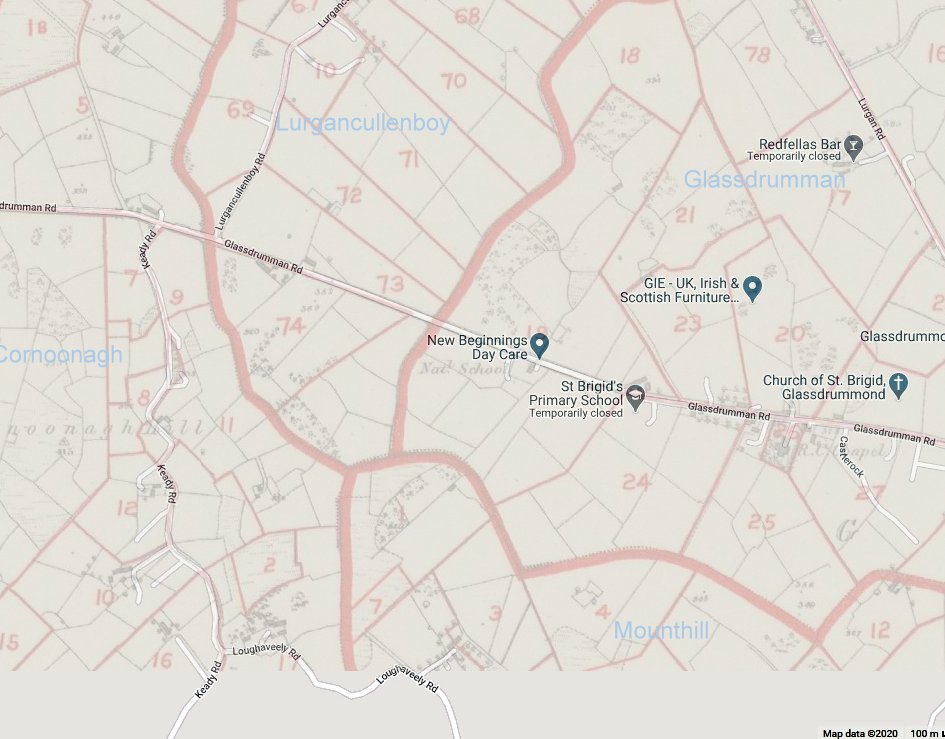
In 1901 Annie is listed as a "Scholar Monitress". It could be that, at 18, she worked in the nearby National
School just to the south of Lurgancullenboy, again in an adjoining townland of Glassdrummond, on the Glassdrumman Road.
The National School building, no doubt renovated several times since 1901, still exists and is still a school (please
see photographs below).
noun. a female student who helps keep order or assists a teacher in school. a girl or woman who admonishes, especially
with reference to conduct.
: a girl who is a monitor in a school
A female school pupil assigned disciplinary or other special responsibilities; a female monitor.
Origin: Mid 18th century (in an earlier sense). From monitor + -ess see -tress.
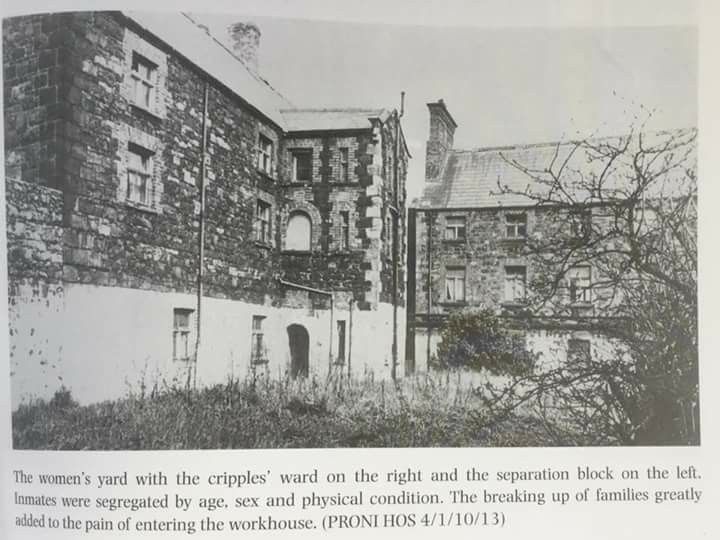
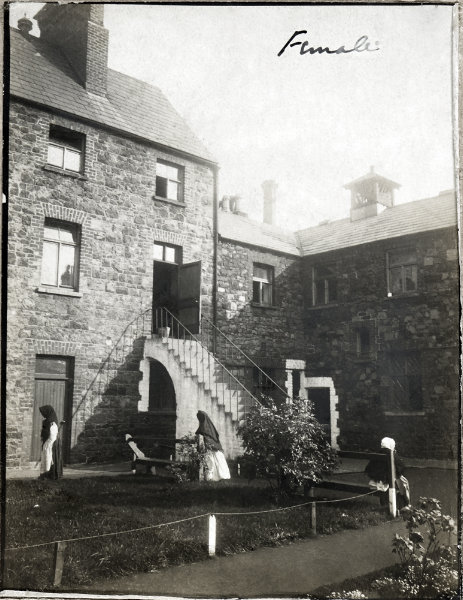
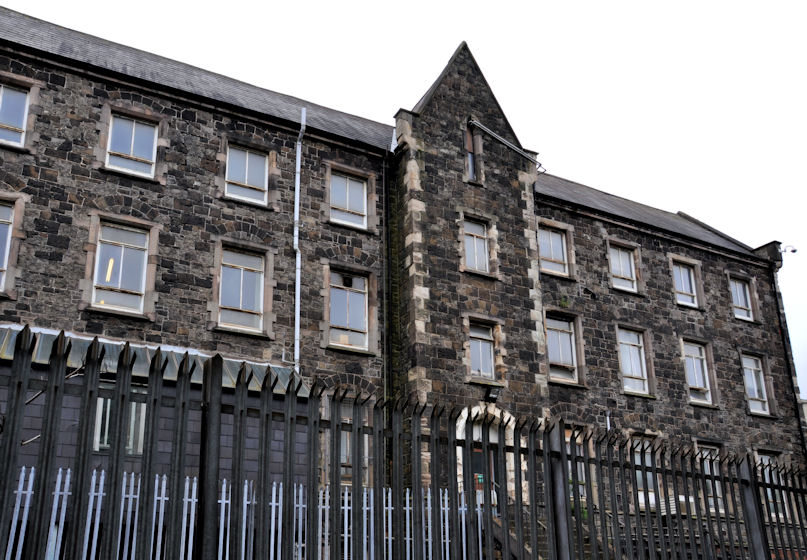
Annie was a nurse at the Union Hospital, Belfast. Belfast City Hospital began as the Belfast Workhouse in
1841. It then became the Belfast Union Infirmary, which by 1869 had over 4,000 inmates. By WW1 it was
called the Belfast Union Hospital and by WWII it had been renamed Belfast City Hospital.
32.0 KB (32,768 bytes) 244 x 191 pixels 72 dots per inch
Please click to expand.
Census of Ireland 1911
Name: Annie Conlon
Gender: Female
Marital status: Single
Age: 29
Birth Year: abt 1882
Birth Place: Lurgan‐Cullenby
Residence Date: 2 Apr 1911
House Number: 51.2
Townland/Street: Lisburn Road
District: St. George's
County: Antrim
Country: Ireland
Electoral District: St. George's
Literacy: Yes both
Occupation: Hosp Nurse
Religion: R C
We find Annie is listed as number 3 on the third page of the Enumerator's Household Return pages; form A
here, but there are 40 of such pages as this in the 1911 census, so I've not included them all. Of course, the
census for the hospital includes the whole population of managers, nurses, other staff, patients and numbers of inmates;
and anyone else staying on the premises on Sunday, 2nd April 1911. The address is 51 Lisburn Road, The Union
Workhouse, St George's, Shankhill.
Form B usually indicates which individuals are tied to which premises, but Annie, along with most of the other nurses, is
not listed individually here, the exceptions being the staff who had their own dwellings in the hospital grounds. The
Workhouse staff and patients are grouped in an entry here - 8487 is edited to 2436 with a note: X The remainder of
the population of this workhouse has been transferred to Ward to which it belongs.
Please click to expand.
The Belfast Poor Law Union was officially declared in 1839. The
Workhouse was opened in 1841 at a cost of £9,869. It was built to house a maximum capacity of 1,000 inmates. The
Belfast Workhouse was built to accomodate people from the areas of Ballygomartin, Ballymurphy, Ballysillan, Belfast,
Carnmoney, Greencastle, and Whitehouse in Co. Antrim, and Ballyhackamore, Ballymacarrett, Castlereagh, Dundonald
Church-Quarter, and Hollywood in Co. Down.
During the worst years of the Great Famine, extensions were put in place to accomodate a further
747 inmates.
During World War I, parts of the Belfast Workhouse were used to house garrisoned soldiers. Later,
during World War II the Belfast Workhouse was used to treat injured civilians who had been the victims of air-raids. The
site later became the Belfast City Hospital.
Today only a small number of the original buildings of the Belfast Workhouse are still standing
in the grounds on Belfast City Hospital.
A small collection of photographs that feature or include Annie McCauley. Most of them were taken on the occasion of
my parent's wedding on the 29th November 1947 at the Brompton Oratory, Knightsbridge, London. It was a
'double wedding'; another couple were married by the priest at the same time.
My brother Benedict and myself attended the London Oratory School in Stewarts Grove, South Kensington. I sang in the
Oratory Church choir in the 1960s.
Annie Conlon - 1956 - Deaths registered in the district of Rathdown.
Annie passed away on the 2nd of August 1956 in St Michael's Hospital, Dun Laoghaire. God rest her soul.
5.12 MB (5,373,952 bytes) 3921 x 5700 pixels 300 dots per inch
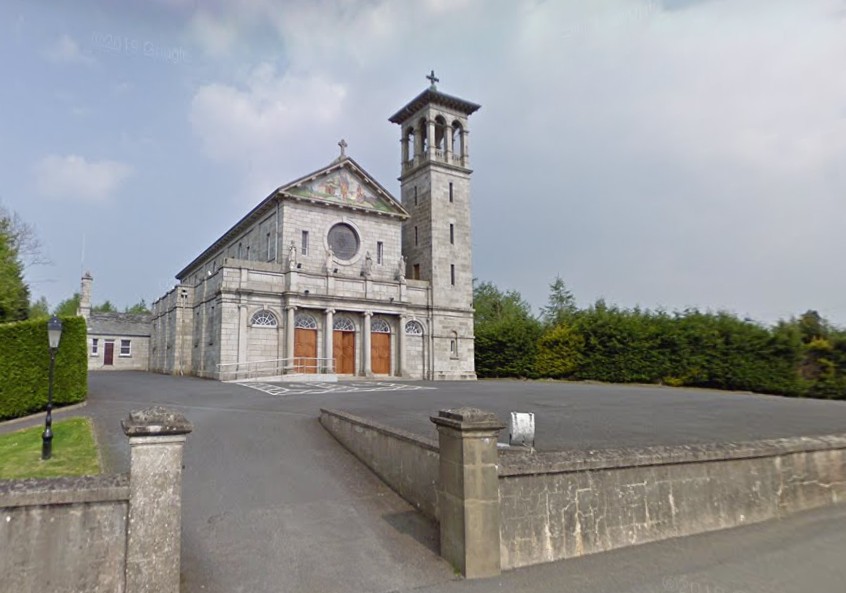
Annie McCauley is buried in Glasnevin - the Prospect Cemetery, Dublin. The Gravestone was designed by my father, her
son, Frank McCauley.
Moire (Maura McCauley, my aunt) is buried in the same plot.
128 KB (131,072 bytes) 640 x 853 pixels 96 dots per inch
Please click to expand.
England Wales National Probate Calendar Index of Wills and Administrations -
Register for 1956
1.12 MB (1,179,648 bytes) 3145 x 2294 pixels 72 dots per inch
Memorial card for Annie McCauley
64.0 KB (65,536 bytes) 282 x 516 pixels 72 dots per inch
Conlon and Short Genealogies
The name Conlon is an anglicized version of the name of an ancient celtic group mainly from the mid north-west, and
partly in the same geographical area as the family of my grandmother Anne Conlon.
The earliest written record of the name or similar in Armagh that I've found is from the Hearth Money Rolls of 8th April
1766 ‐ PAPISTS IN THE CO. OF ARMAGH PART OF THE PAR. OF CREGGAN 8 in the townland of Anaghmar 228 Loughlin
Conelan and 229 Widow Conelan. In Corneonagh townland, number 496 is Thomas Connelan. While the former
Anaghmare Townland is a few miles north east of the Lurgancullenboy area, I take the latter to be an old spelling of
Cornoonagh Townland which adjoins Lurgancullenboy, so it's possible that Thomas could be our ancestor. In the
Tithe Applotment books of the 1820s, the name in Anaghmar was now recorded as Conlan and in Cornoonagh Townland there
was James and Thomas Conlon, the surname shared by then in several households in Creggan Parish, and recorded for the
first time in 1827, in Lurgancullenboy, one Michael Conlon. There are Short and the ancient McCardle surnames
proliforating throughout history on the surviving documents.
The research compiled by myself with many contributors in the 1980s and 1990s is well out of date by now. I see
updates on file at Ancestry dot com for some of the families here and intend to make further revisions.
The Short family information came mostly from Mrs Greta Agnew and her brother Con Short. I was in correspondence with
them both at the time as they were also interested in genealogy. I wrote to several cousins in America which was
fruitful.
There are photographs for some of Annie's sibling in the earlier generations that need sorting out and posting here.
Letitia McCauley
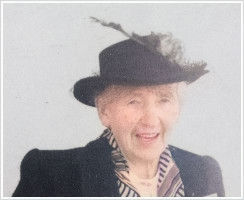
John McCauley's only sibling was his younger sister, Letitia McCauley, a
lace school teacher and a spinster, born in Balaghadereen on the 19th July 1872. Letitia died in Dublin on 24th
August 1945. I was told that Letitia liked to wear only brown clothes. Sadly for us, not one photograph exists
of her and apart from the official documents, no personal papers or writings are left to tell us more about her. It's
guesswork when speculating as to where she taught lace making. My late Aunt, Maura Letitia McCauley was named after her.
John and Letitia's father, James was a Royal Irish Constabulary man. He was stationed in
Roscommon following recruitment in Dublin and then to Mayo in 1870, retiring in 1890 to life in the town of Killala.
After James died on the 10th February 1901, Letitia looked after her mother Eliza in Killala and when Eliza passed away on
17th September 1919, Letitia then joined John's family in Blackrock, moving with them eventually to Neville Road in
Dublin when the McCauleys moved there from Dundalk, Louth in the mid-1930s.
On the 1901 and 1911 Census, Letitia and her mother both lived in the end house in Gore Street, Killala, enumerated to
number 96 in the census. There's a romantic story of a friendship between Letitia and their neighbour, probably
Henry Knox, a relative of the local landowners whose estate included their house and most of the land and tenantry for miles
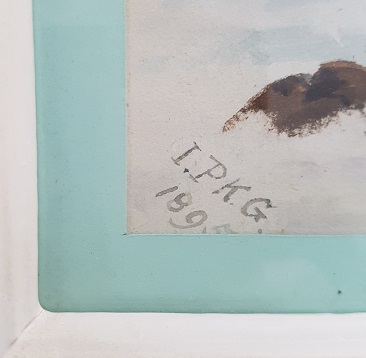
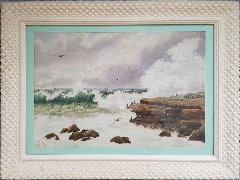
around. I have inherited a good seascape watercolour from my late Uncle Jim McCauley, which was a gift to Letitia,
possibly from Henry Knox, signed I.P.K.G 1905 - likely to be Henry's relative, Isabel Pery‐Knox‐Gore, the
landlady in Gore Street.
There's another story about a family visit to Killala and the noticing of the sound of clinking bottles under
Eliza's bed!
64.0 KB (65,536 bytes) 282 x 516 pixels 72 dots per inch
Church Record of Baptism for Letitia McCauley
Catholic Parish Registers Diocese Achonry, Castlemore and Kilcolman.
Eliza Quinn Spouse James McCawley Child Letitia McCawley 23rd July 1872 - (born 19th July 1872)
In 1860, Ballaghaderreen Cathedral was dedicated as the cathedral for the Roman Catholic Diocese of
Achonry. Ballaghadereen is part of the Barony of Costello and in the parish of
Kilcoleman.
Prior to 1898 the town and parish of Ballaghaderreen and Edmonstown was located in the eastern part of County Mayo until its
transfer to County Roscommon under the Local Government Act 1898 by the Parliament of the United Kingdom. This has
led to some anomalies, for example the local Gaelic Athletic Association team, Ballaghaderreen GAA plays in the Mayo
championship and its players represent County Mayo.
It's probable that Letitia was named after her Grandmother, Letitia Quinn (nee Dolan).
544 KB (557,056 bytes) 1332 x 839 pixels 72 dots per inch
Water Colour
A gift to Letitia from an admirer. This came down to me via my Uncle Jim and to him from Letitia. I reckon
this was given to Letitia McCauley by Henry Knox, their neighbour in Gore Street, Killala. It's a lovely
watercolour by Isabel Perry Knox Gore, the McCauley's landlady. She was about the same age as Letitia.
The Knox Gore family were local landowners of large swathes of the land and properties in and around Killala, and all over
Mayo. One of their homes, The Lodge, in it's own grounds is situated just beyond what was the McCauley residence
in Gore Street.
Isabel Sarah Pery-Knox-Gore was the daughter of Edmond Henry Cockayne Pery‐Knox‐Gore and Sarah Jane
Knox‐Gore. When Isabel Sarah Pery Knox Gore was born on 6th January 1868 in Ballina, Mayo, her father,
Edmond, was 40, and her mother, Sarah, was 25. She had six brothers and four sisters. She moved to
Hafod, Aethwy, Anglesey East, Wales in 1939. She died on 5th December 1945 in Anglesey at the age of 77.
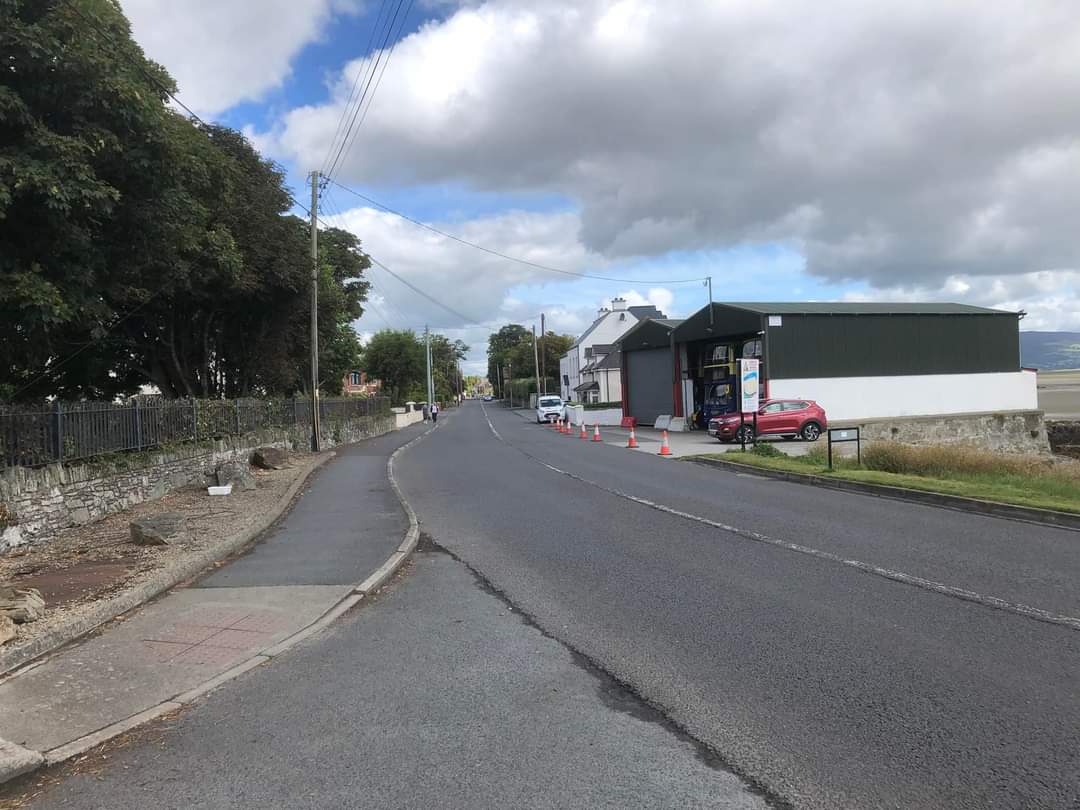
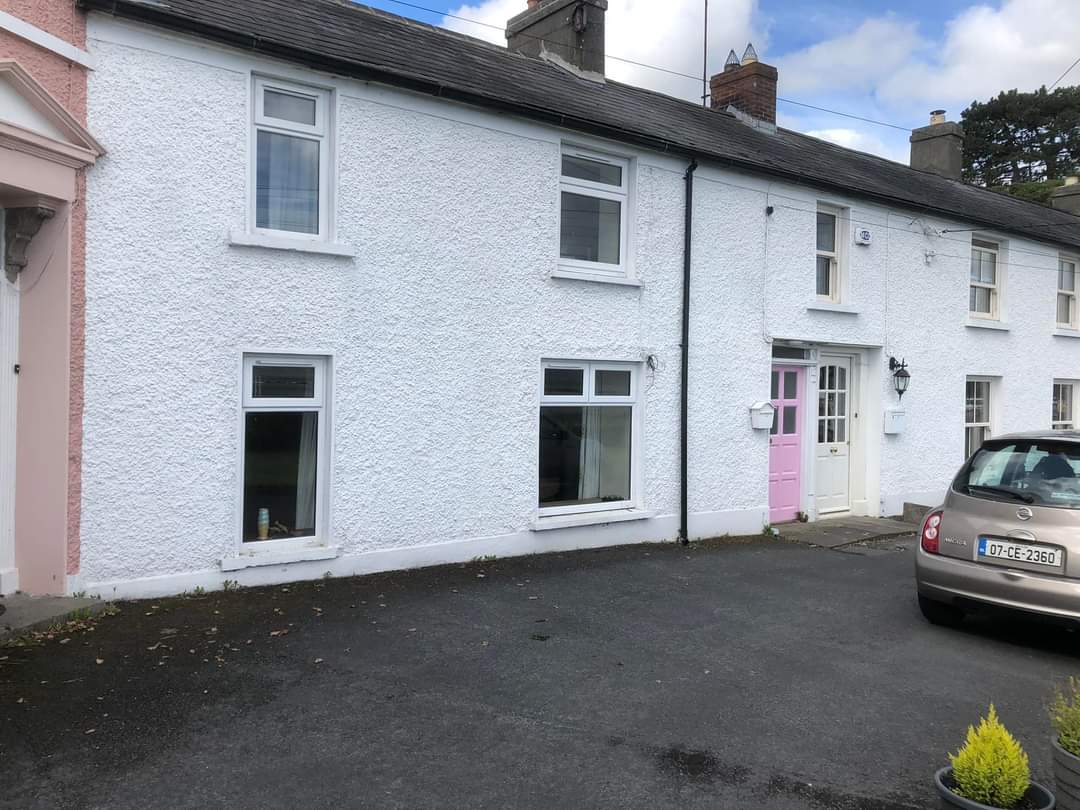
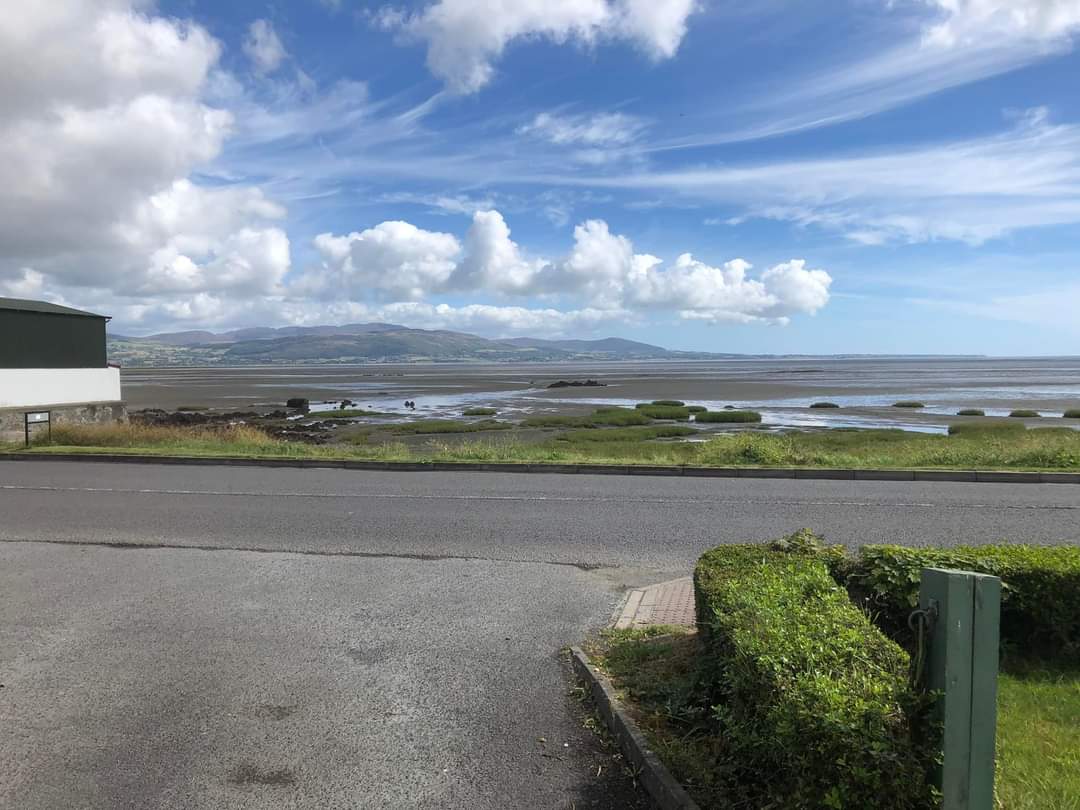
Description: A house with foundations dating from the 17th century, visited by Mary Delaney in the 1730s and
occupied by the French in 1798. By 1837 it was the home of T. Kirkwood and, in the mid 19th century, of the Very
Reverend J. Collins who
held the property valued at £20 from the Ecclesiastical Commissioners. In the late 19th century this house
was the home of Captain Alfred Charles Knox, a younger son of John Knox of Castlerea, Killala. Bence Jones writes
that the house was enlarged circa 1820 by the addition of a bow shaped wing and that for a time it was the home of the
Pery Knox Gore family. In the later 19th century the house was the home of the Timony family who owned a
substantial import business in Killala. In the later 20th century owned by Lord Rathcaven and now the Irish home
of Noeleen Farrell.
The picture originally had a thin black frame, which was not in great condition. My cousin, Teresa Stafford, gave
me the frame that's in the photograph, which she'd found in her attic, saying that it gave her the creeps.
It was originally faded gilt and I decided to paint it white.
1.21 MB (1,277,952 bytes) 3147 x 2360 pixels 72 dots per inch
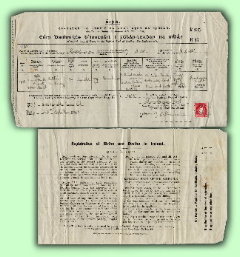
Letitia McCauley ‐ 1945 ‐ Deaths registered in district2 Rathmines in
Dublin.
Letitia passed away in Neville Road on the 24th of August 1945. God rest her soul.
5.12 MB (5,373,952 bytes) 3921 x 5700 pixels 300 dots per inch
Death Certificate of Letitia McCauley
64.0 KB (65,536 bytes) 282 x 516 pixels 72 dots per inch
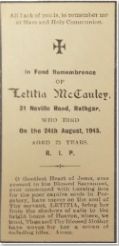
Memorial Card for Letitia McCauley
No photograph - there's only Letitia's name on this mass card. God rest her soul.
64.0 KB (65,536 bytes) 282 x 516 pixels 72 dots per inch
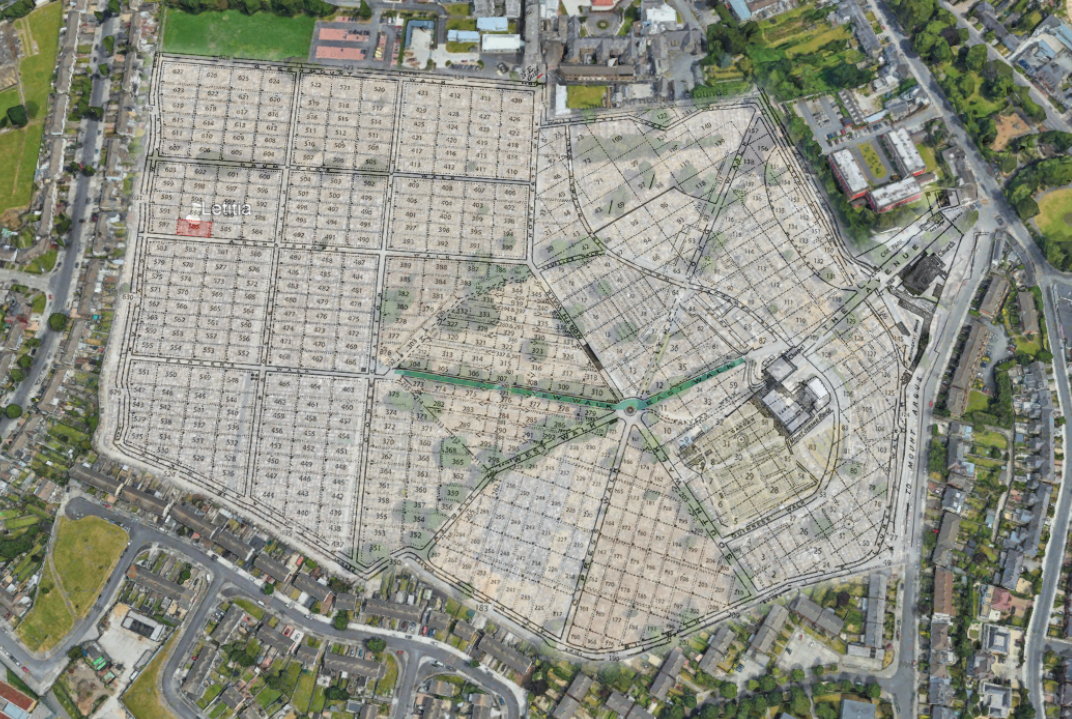
Mount Jerome Cemetery, Harolds Cross, Dublin.
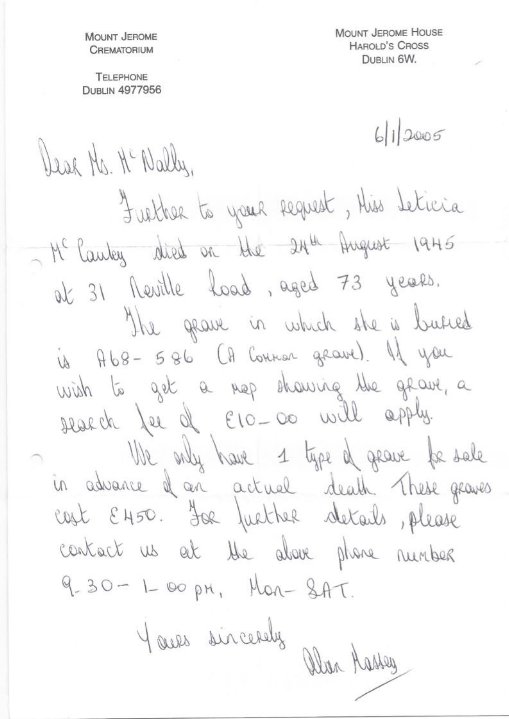
In 2005, my cousin Geraldine McNally wrote, that, due to a workers dispute going on in August 1945 at the Prospect
Cemetery (Glasnevin), Letitia was buried in Mount Jerome Cemetery, not far from Neville Road.
Subsequent to a visit, Geraldine ascertained that she was buried in plot number A68-586 in Mount Jerome Cemetery.
Apart from the official documents, and luckily there are quite a few, there's nothing left to us to help record the life
of my great grandfather James. At 19, as a new recruit to the Royal Irish Constabulary, the RIC, he must have
presented a birth certficate or affadavit to the authorities but, to date, I've been unable to find copy.
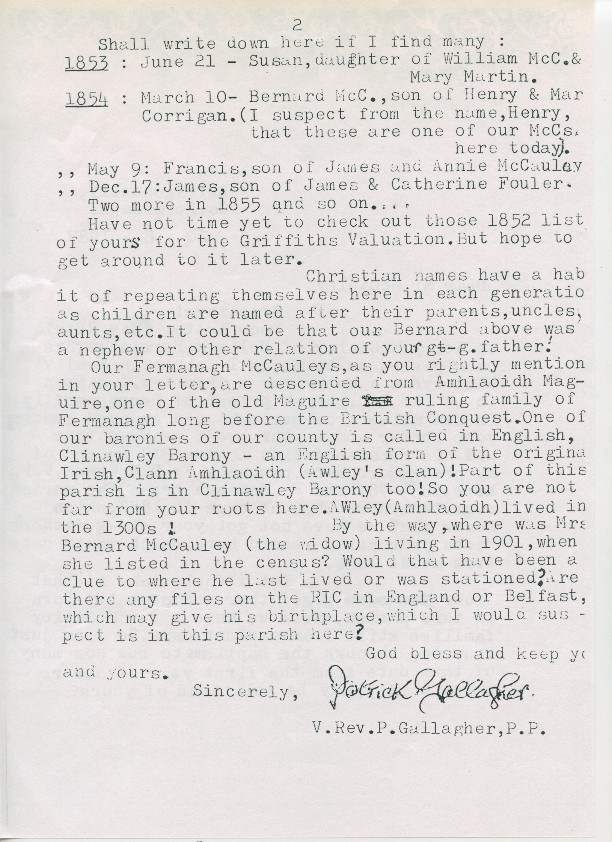
In the 1980s I found details of the Parish Priest who, in the 1860s, was the referee on James's RIC record.
Father P McKenna was the Parish Priest of Derrygonnelly in Fermanagh. This of course does not necessarily mean that
James was born there but he would have known Father McKenna in the 1860s. In 1987, I had a reply from the then
current Parish Priest of Derrygonnelly - Father Patrick Gallagher..
His RIC personnel record does read that his native county was Fermanagh. The family story is that he'd run away
from home. Both my dad and my uncle Jim did mention to me that they thought that there was a "scottish
connection". For these reasons the focus here is on James's RIC career. It did occur to me that James
would have been around the age of seven at the height of the Great Famine.
In James’s day and fortunately throughout most of his 30 year and 3 months career in the RIC, policing generally
became a routine of controlling misdemeanours such as moonshine distilling, public drunkenness, minor theft, and wilful
property crimes. Industrial boom years for the British Empire and throughout, Ireland continued the long fight for
independence from Britain’s union of 1801 and what amounted to their racist, careless and laissez faire attitudes
to Ireland during the Great Famine and evictions. Following the Young Ireland rebellion of 1848, direct action began
with the Fenian Rising of 1867. Fenians attacked on the more isolated police barracks and smaller stations. The
Land War broke out in the 1879‐82 depression period towards the end of James’s career. Home Rule was the
dominant political movement of Irish nationalism from 1870 to the end of World War One.
Born in 1841, James’s occupation prior to his RIC career was that of a "Sawyer", a worker in timber.
As well as widespread forestry immediately to the south of Derrygonnelly, Florencecourt Forests, where timber yards are in
business to this day are about twelve miles from Derrygonnelly, and in the 1901 census there is on record, a resident and
his family, Bernard McCauley aged 75, just about old enough to be James's father.
With a character and reputation described by my aunt as a "Martinet", the stringent conditions for a sub constable
must have taken their toll. From the same single page of the huge ledger in the records office in Kew, London, one can
readily observe that a high percentage of the recruits dropped out or resigned from the force.
Stationed in Roscommon he met our great grandmother Eliza, a farmer's daughter from Keadue. In 1880, the year
after they married, James was reallocated per the rule from Roscommon to another County ‐ Mayo and the town of
Ballaghaderreen (now reverted to Roscommon), where my grandfather John and his sister
Letitia were born.
For a possible Scottish connection, there’s a large group of McCauleys up in Antrim that are recorded in one of the
Catholic parish registers but our James did put his native county as Fermanagh on his application to the RIC and this is
likely to have been strenuously verified.
On 1st October 1883 there was a change of designations of certain RIC ranks. Constables and Acting Constables became
Sergeants and Acting Sergeants. Sub Constables became Constables.
I've just recently found records preserved in the Court Petty Sessions archive; James, in his RIC capacity, being
the witness or complainant. Along with several interesting cases, they provide good tracking for his location.
There could well have been further involvements (on the side of the law) with more serious crimes, but these would
have been recorded elsewhere and papers no longer exist as far as I'm aware.
Apart from a rape case commandeered by his district inspector and a case where James was assaulted, the impression one can
easily get is anything for a quiet life with appearances so few and far between over the 30 years career, years of
momentus events in Irish History. This could be evidenced by the fact that it took so long ‐ 21 years ‐
before he was promoted to Sergeant (Constable) in 1881. Although the Petty Sessions cases were often recorded
in the newpapers, I've not found any that mention Constable or Sergeant McCauley. I'm pretty sure that James,
like most level‐headed Sergeants, kept his head down, looking forward to retirement and the pension. A good
percentage of the court cases in which James was involved were dismissed or resulted in a low fine. Of course, the
RIC's role in the Land War, particularly in County Mayo, would be a reason for shame, in my opinion. Many in
the ranks resigned and emigrated for related reasons. James was finally allocated to the townland of Farmhill,
Rathrea, a place of some notoriety in the Land War and "agrarian unrest" ‐ the real
"outrage" being the evictions in Rathrea.
In a simlar way that his son, my grandfather John, was moved around in the country wherever and whenever required by the
authorities, he must have been very happy to finally settle into retirement in Killala, County Mayo in 1890. His son
John took his Civil Service entry exams in October 1891, and went off to work in Dublin leaving the family of James, Eliza
and Letitia McCauley in Killala.
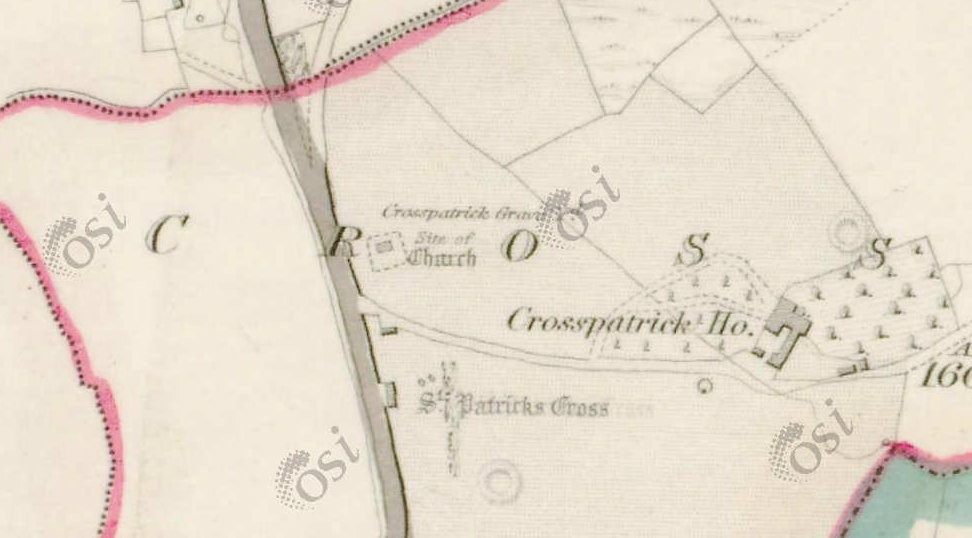
James died in 1901 and is buried in Crosspatrick graveyard just outside Killala.
In this topic we will look at how candidates were initially assessed and why they were given a police number.
We will reference the relevant sections of the Constabulary Code that had to be complied with as part of the recruitment
procedures leading up to attestation as a constable.
It would appear to have been a three-stage process; at the core of which was a bureaucracy designed to minimise the
potential expense to the public purse.
Stage One
A candidate for the police would have either approached, or been approached by, a policeman in the district where that
man lived. He would have been identified as a strong and physically active young man, with some degree of
education or intelligence, and from a good and stable family background. His name would have been entered onto
the local 'Register of Candidates' (Section 1572 of the Code) and would be marked a a 1st Class or 2nd
Class candidate, depending on his height and education (Section 1578). 1st Class candidates had a better
chance of being selected for presentation at the Depot. These rules persisted into the early years of the RUC also
and were still quoted in 1926 updates of the original Code ‐ with a 3rd Class of candidate added by this time.
The RIC Constabulary Code was very clear that all candidates admitted into the Constabulary Force must enter either as
Cadets (in the case of Officers), or as Constables (Sections 1562 and 1577 of the RIC Code 1911).
To be admitted as a constable he had to have certain mimimun height and chest measurements, he had to be literate, and to
know simple arithmetic. There were additional factors to be taken into account such as dental health, tattoos, any
family history of insanity or consumption; character references to sobriety, honesty and fidelity.
Stage Two
The first level of checks was done by the County Inspector or his designated subordinate ‐ usually a District
Inspector although this could vary ‐ and was undertaken at a place and date set by the examining officer.
The candidate presented himself there and was given a series of literacy and numeracy tests, and his key measurements
taken (height, chest) as well as other details being noted. The candidate had the option of undergoing a
full medical examination at the same time but he had to pay any fees himself (Section 1585). This is an
important point; and the availability of a doctor, and meeting the expense of any fee, was often beyond the ability
of the young candidate in many impoverished areas.
In some places, a Military Surgeon could be found and this was undertaken without public expense. Otherwise, the
candidate had no option but to travel to Dublin and present himself at Depot to be examined there, at which point he may
have been rejected.
The candidate, provided he had passed the local District Inspector examination criteria, was 'Attested' into the
force ‐ that is, sworn in as a Constable ‐ and given an RIC number. This was done in the County (
Section 1589 of the Code) and finally approved in Dublin on Form 3. The number may not have been immediately
given, but would have been allocated as part of administration across all counties within a given recruiting period.
The important point was that any expenses incurred ‐ eg travel warrants, clothing allowances, food and rations
‐ could be allocated to accounts and if necessary reclaimed if the candidate subsequently withdrew voluntarily.
This number was the accounting mechanism by which the Force, and ultimately the debt incurred by the Castle, could
be financially managed.
Stage Three
This was examination at the RIC Depot in Dublin. Height and chest measurements were again taken, as were literacy
and numeracy tests, and crucially, the medical exam. This may have been the first time a young lad had ever seen a
doctor, and the point at which any shortcomings may have become apparent.
We can look now at at some examples from the (very) few attestation forms that still survive.
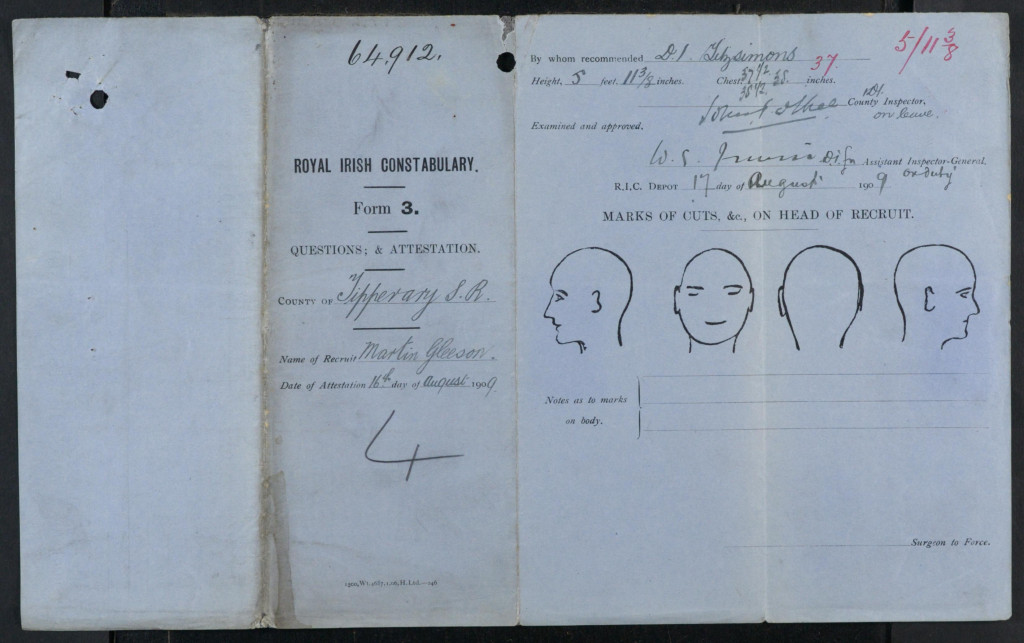
Form 3 Questions and Attestation
This was completed at the initial stage by the examining District Inspector and forwarded to the Depot. Here we
are looking at Constable Martin Gleeson 64912, a lad who joined from Clonoulty. He was recommended by D.I.
Fitzsimons and attested ‐ appointed ‐ on 16 August 1909.
Only basic health and measurements were looked at by the police, Gleeson presented himself to a military doctor the same
day at Clonmel and was passed as medically fit. See the Medical Certificate on the second page of Form 3.
He swore his oath on the 16th, so then being attested into the police; and the next day, at Depot, he was again finally
pronounced fit by the doctor acting for the RIC Surgeon.
One final bit of evidence, achieved some years earlier, was the production of a vaccination certificate ‐ also a
requirement ‐ I believe this related to compulsory smallpox vaccinations across the whole of the UK and Ireland.
A vaccination certificate plus a copy of the birth certificate accompanied the Form 3.
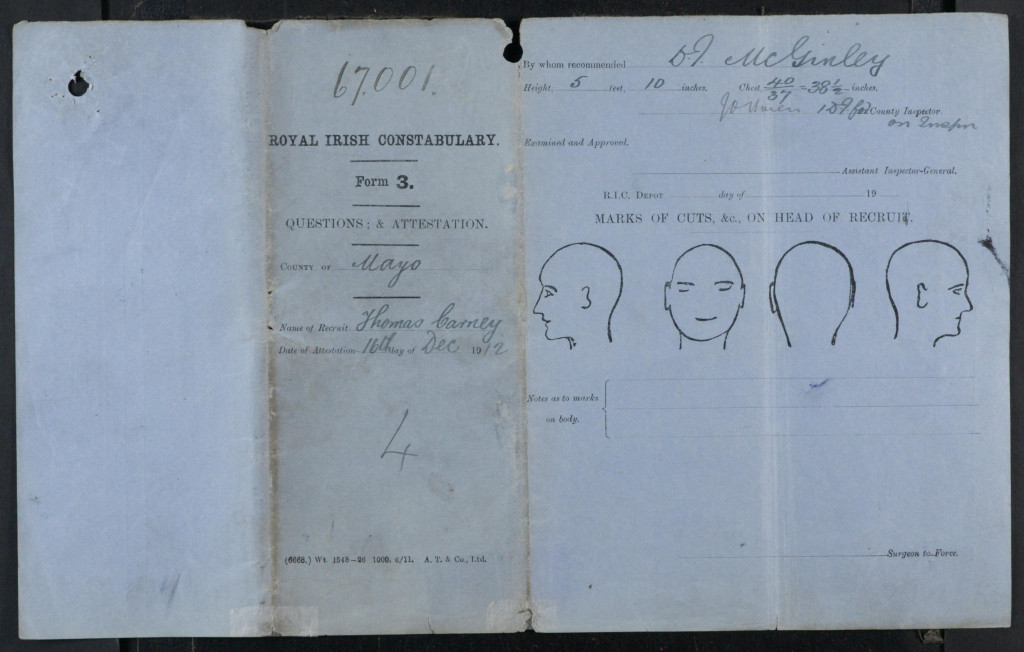
An Unfit Case
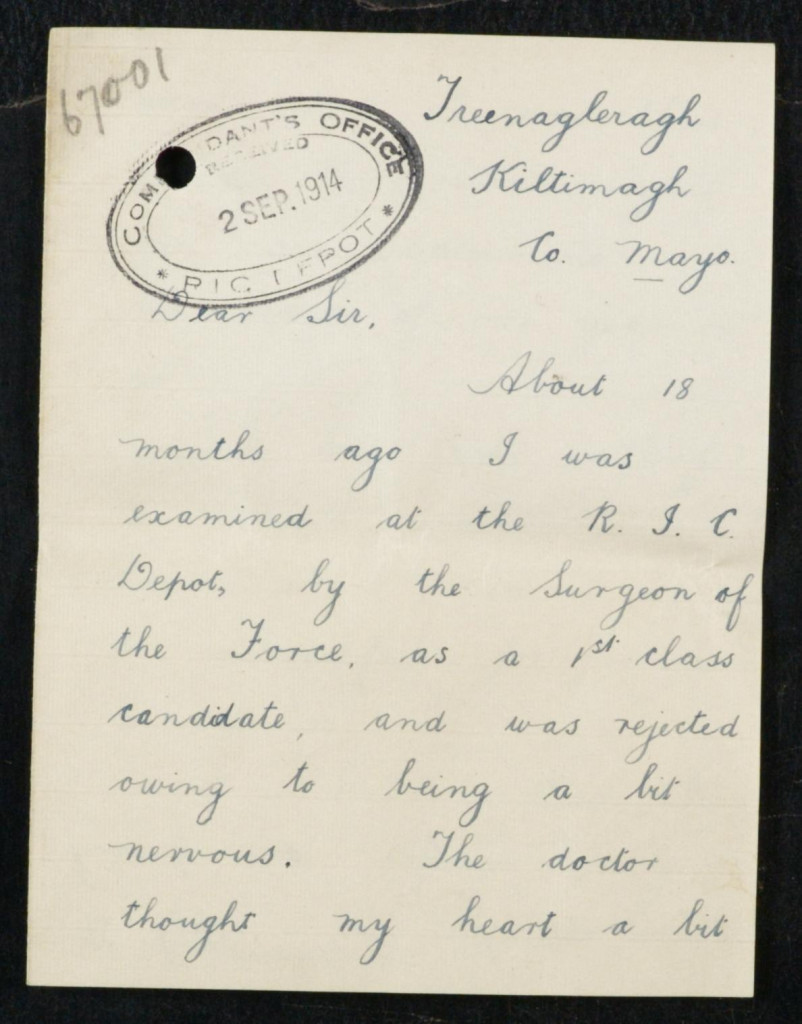
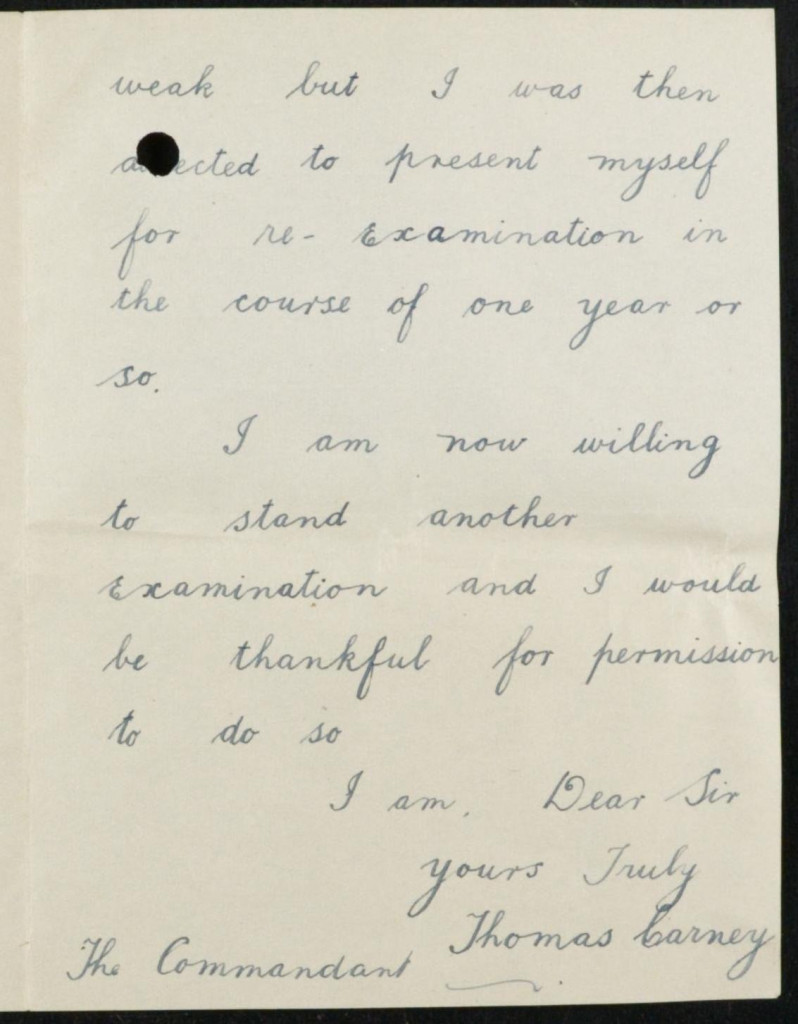
Here we have Constable Thomas Carney 67001. He was recommended by D.I. McGinley in Mayo and his Form 3 completed
16 December 1912, when he was attested having been found 'fit' by a medical examiner in Castlebar. The
Form 3 was accompanied by a copy of his Birth Certificate.
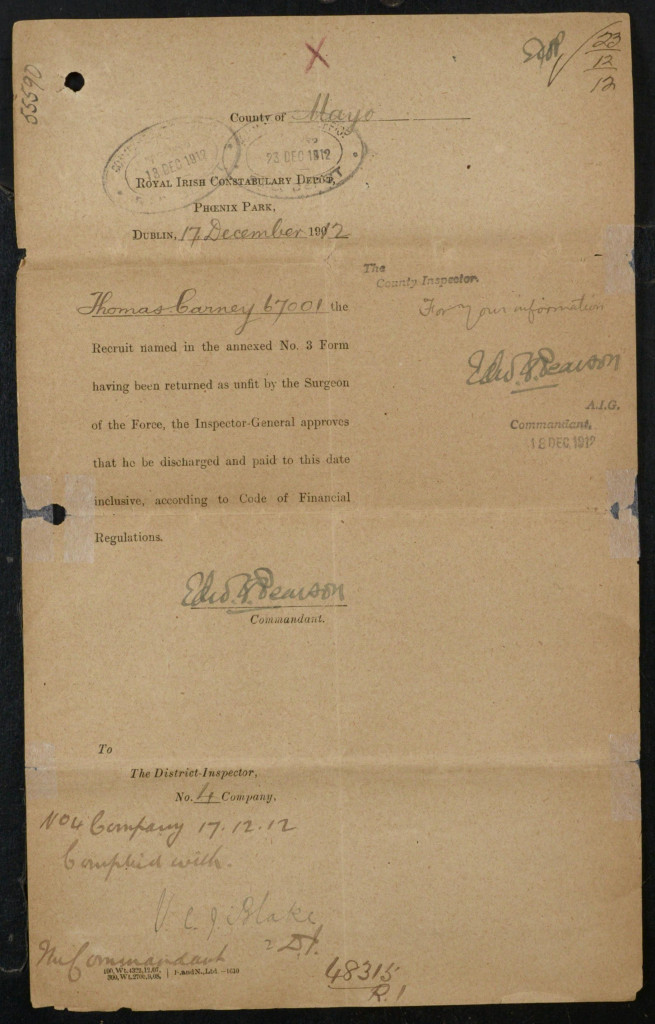
He must have then been sent to Dublin a day later, but was rejected ''Unfit by Surgeon' on the 17th December
‐ his papers are endorsed 'Unfit' and annotated 'Weak Heart'. His discharge form officially
notes that he was discharged 18 December and he received effectively one days police pay in this time.
He re-presented himself nearly 2 years later with the following explanation ‐
He then re‐applied for the police, was examined again locally and at the Depot, received a new Form 3, and was
appointed 1 Oct 1914 with the same RIC number.
Without the original Form 3 or other supporting papers we may never know the exact reason for a candidate being found
unfit. It may have been some minor deficiency which could have been overcome with time, or something more obvious.
The RIC were highly selective in those days, and a candidate's physical measurements or health were often
good enough for service in many other police forces, on the UK mainland or overseas, but fell short of the high standards
expected in the Irish Police.
Personnel Record 25644 McCauley Jas
In the 1980s I applied and received a readers ticket for the Public Record Office at Kew. This massive building,
shielded against nuclear attack with it's thick concrete walls, holds the majority of the remaining original 64
personnel registers and RIC publications. On each visit, there were a maybe thirty or more people in the library room
quietly looking at all sorts of papers.
This page comes from one of a set of ledgers that are unweildy huge tomes. White gloves are required for a reader to
safely look at them ‐ for his or her research and one must order the ledgers from the staff, using a reference index.
Not possible to photocopy, I took down all of the details for each header for James ‐ a transcript follows.
I also looked for some of the rules and regulations, particularly those pertaining to the references against
James's Personnel record. Nowadays, all the registers are digitized and are available on line.
Of the ten recruits on this page, only our James and one other reached the pensionable retirement ‐ the other eight
were either dismissed or resigned, three emigrating to New Zealand, Australia and America, another resigning "To go
home, having family affairs to manage", and one poor fellow, deemed unfit for the job by the surgeon. Not a
particularly exceptional page ‐ and it gives a idea about the effects of hardship and the rigorous demands of the RIC
in the 1860s.
1.87 MB (1,966,080 bytes) 6736 x 4841 pixels 96 dots per inch
Some of the most frequently asked questions relate to personal or personnel records of individual RIC men; whether
they still exist, what remains, and where they are located. Various references on the RIC service records, usually
relating to favourable records or disciplinary offences, are a particular source of frustration to family historians.
When advised that further service details are lost or no longer available, I have often been asked 'are they
still at Kew?', or 'are they still classed as secret'.
The truth is that nothing of great significance survives beyond those papers lodged with the National Archives
(London), or the smaller sets to be found in Ireland (National Archives and Garda⁄PSNI Museums).
We have seen in the above post how many papers were officially destroyed in the spring of 1922, and how this was
carried out at the local level. Only on rare occasions did some of these registers and ledgers escape the cull.
What is less well known is the sequence of events which saw the initial storing, and subsequent reduction, of these
historical documents. Indeed the wonder is that anything survived at all.
(Most of what follows is a synopsis from Gerard O'Brien's excellent study on missing RIC personnel files).
The problem of what to do with the police (RIC and DMP) intelligence and personnel files was of particular
concern to the British authorities, as they prepared to leave Ireland in early 1922. According to one Irish Office
official, the Crimes Special and Secret Service files in the Castle amounted to 'one hundred deed‐boxes, half a
dozen large packing cases, a couple of six‐foot‐high cupboards, along with thirty eight card‐index
trays (twelve of them in cabinets)'. These were initially lodged in the Tower of London for
safe‐keeping, but by 1923 had all been destroyed.
A similar fate fell to records of intelligence, double‐agents, informers and secret service officers ‐ these
were burned on the spot either locally or at the Castle, deemed too sensitive to fall into the hands of the new
government. It was probably a wise decision in light of subsequent events in Ireland, but a tragic loss for the
historian.
Even more of a problem was the huge amount of miscellaneous and personnel records relating to the RIC, which could not be
safely left with the Provisional Government. To give some scale of the paper mountain, this amounted to some 432
yards of shelving (files for 46,000 men, including pensions, discharge, resignation papers etc); another 432
yards of shelving relating to books and registers; some 40 yards of shelving for Crime Files since 1916; and
another 32 yards of shelving for attestation papers, birth certificates and army papers of 24,000 men. And this
was not even the full extent of the paperwork.
This mountain was initially lodged in Rooms 9 & 10 of the Home Office's Queen Anne's Gate premises.
By July 1924 the British Office of Works, desperate for space, was urging its complete destruction. We owe the
survival of much of what is left to a British civil servant, Mr A. Crapper, who alone saw its value ‐ primarily to
assist in financial compensation, pension and litigation cases. ‐ He fought a long struggle.
The problem was that, following disbandment of the RIC, there was no logical home for its records. No RIC
officials remained to categorise and store the files, no existing government or civil service body was the proper home
for the archives; nobody had responsibility. The problem was only compounded when the Irish Office itself was
dissolved in 1925 following the report of the Boundary Commission. In this same period all the Crime Special files
and registers relating to the Irish Republican Brotherhood and United Irish League members dating back to the 1880's
were destroyed.
In 1926 the papers were again moved, this time to a sub-basement (Room 57) in King Charles Street. In 1927
water was seen seeping into the basement, many records were seriously damaged. Once again, officials took the
opportunity to weed out and destroy documents deemed as 'no longer required' ‐ and we lost forever
post‐1916 Crime Special files and registers, financial documents, and DMP station record books. Other papers
remained to moulder there until 1931 when (our heroic Mr Crapper being involved again) a number of secret and
confidential papers were moved to vault No. 6 at 3 Whitehall Place. The remainder of the now foul‐smelling
contents of Room 57 were destroyed.
The RIC personnel files and registers saved earlier from Room 57 meanwhile remained at 'Court 9' of the Office of
Works, and by 1934 included medical history sheets and enlistment papers of the Auxiliary Division. Also here
were 'dispersal payments' to Auxiliaries and seven lockers made of wood and tin which had belonged to individual
RIC men. In 1935 they again were moved ‐ now to Whitehall's New Public Offices ‐ along the way
more papers were destroyed because .."they immediately disintegrated on touch, and were so evil‐smelling that
Westminster City Council sanitary inspectors were forced to order their removal and destruction on public health
grounds".
In September 1939 the papers were again moved, this time to Elstree. The cargo included "RIC Crime Special
Registers dating from 1893 to 1910, Surrendered Arms documents, five volumes of DMP reports, two volumes of RIC eviction
reports, seven RIC Occurrence books, 200 bundles of 'personal papers', and a number of RIC codes, lists,
circulars and small registers".
This transfer, to quote Gerard O'Brien, was crucial for two reasons. First, the 200 bundles of 'personal
papers' almost certainly comprised the 46,000 personnel files found by Mr. Crapper in 1924 and kept in existence
safely since that time. Second, these papers were never seen again.
No one knows fully what happened at Elstree. Certainly, a note in 1940 that RIC registers no longer needed for
pension purposes by the Treasury could now be stored at the Home Office was the initiation of the HO184 series now
(finally) stored in the National Archives, Kew. The remainder seemed to be gradually destroyed, in line
with civil service practice, 6 years after they were no longer needed for pensions purposes.
The loss of the personnel archive is of course a tragedy. But it is still remarkable that so much information has
survived ‐ the only police force in the world where such an amount of material has been saved.
Awards - 2 HyS: a 2nd class favourable record maybe for good police duty or bravery which was published in the Half Yearly Supplement, similar to the Gazette. Jub Rec – Jubilee Record. See below.
Punishments Index Letter & No. of Papers relating to
-
If Discharged Dismissed Resigned or Dead State the date thereof also the Index Letter and No. of Papers having reference thereto.
Pensioned 1 8 90 25644D 44416
Commencement of Pension on retirement
Injuries Received on duty Date of Report and Index Letter
-
Whether on quitting the Service allowed Pension or Gratuity Amount £ s d
72 00 00
Gratuity to Family if Deceased Amount £ s d
-
If dead probable cause of Death If resigned, why.
-
Observations
-
224 KB (229,376 bytes) 992 x 1357 pixels 240 dots per inch
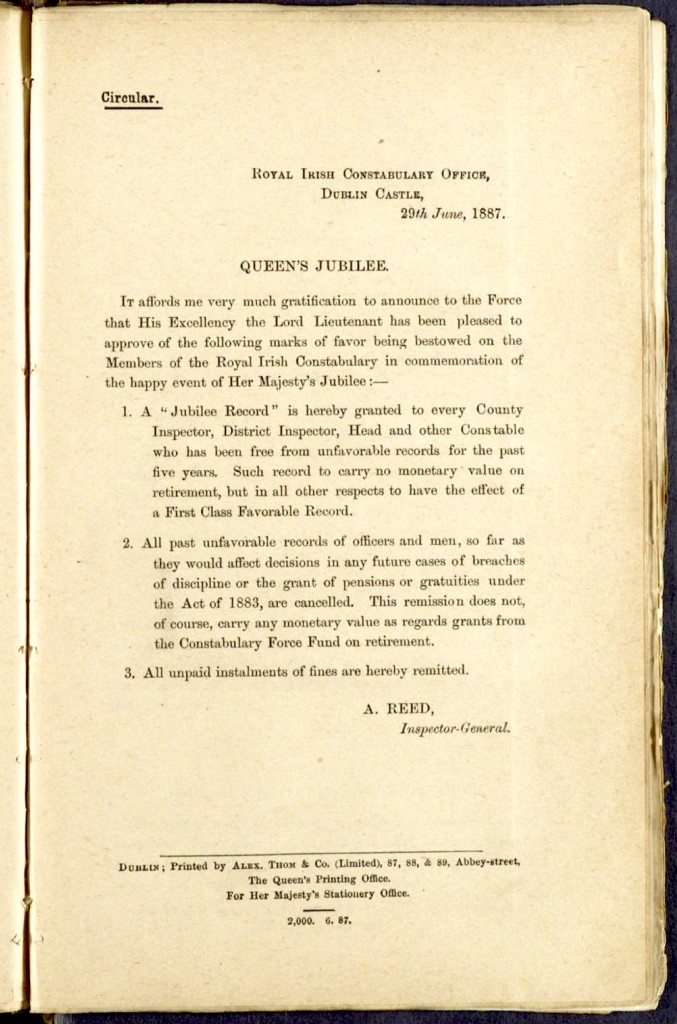
Researchers will often see the annotation 'Jub Rec 29⁄6frasl;1887' (or similar) in service records.
This is the 'Queen's Jubilee Record' that arose when, the occasion of her Jubilee in 1887, Queen
Victoria was pleased to accord special favours to the R.I.C. The Inspector-General issued a circular in June 1887 to the
effect that ‐
All men who for the past five years have had no offence reported against them are to receive favourable record, promotion
or pension, whilst those who are defaulters, and undergoing punishment by fine, or are under notice of dismissal, are to
have their offences condoned and continue their services with a clear sheet. Other minor favours are also to be
awarded, all of which give great satisfaction.
The full circular is shown below (Ref: National Archives HO184⁄116)
London Gazette Extraordinary, 14 March 1898, No.26947
"On Sunday, June 20th 1897, The Queen attained the 60th Anniversary of Her Majesty's Reign, this being at the
same time the longest Reign recorded in the History of these Realms."
Tuesday 22 June 1897 ‐ HM Procession from Buckingham Palace to St Paul's
The Queen left the Grand Entrance of Buckingham Palace at 11.15 o'clock, in State, and drove through London for the
purpose of seeing Her People and of receiving their Congratulations on having attained the Sixtieth Anniversary of Her
Majesty's Reign.
The RIC Mounted Troop had a place of honour, forming the escort immediately behind the Queen's carriage, following
the rear echelon of the 2⁄Life Guards.
Pension Registers - New Pensioners
Also kept at the Records Office in Kew, here is the page in the register of new pensioners that includes James McCauley.
By the time he was pensioned on 1st August 1890, he was a ‘thirty years man’ – 30 years and 3 months
service. Sanctioned on July 15th 1890, the pension amount of £72 per annum was to commence on 1st August 1890,
with further authority issued to the sub inspector and the audit office. Worth approximately £9,312.90; about
€10,239.78 today ((CPI Inflation
Calculator), it may seem a meagre amount but the buying power of his pension income was far greater in 1890 than
today.
As indicated, James, in work, was a contributor to the Constabulary Force Fund ‐ a kind of life insurance.
There are two types of books related to the Constabulary Force Fund. One is the correspondence registers which contain
lists of members names who paid into the fund with notes regarding whether the person had been pensioned, died, or received
any rewards from the fund. The second set of records show the names of constables whose widows or children received
monetary awards from the fund.
2.37 MB (2,490,368 bytes) 5759 x 4502 pixels 96 dots per inch
Pension Registers - Payment Records
James took his pension at age 49. Although still a young Sergeant, he'd completed a 30 year old RIC
career, a physically rigorous and stressful job. Many others took their pensions at around the same age.
He must have been very happy to take a relatively good pension and retire in the lovely town of Killala
on the Mayo Coast with his wife and daughter. In the section on Eliza McCauley I've included photographs
of the house in Gore Street where James, Eliza and Letitia lived, as well as the 1901 and 1911 census returns.
His oldest, John, my grandfather, had already passed his Civil Service Exams at age 20 and was working in
Dublin by 1891. James had already sadly passed away by the time the 1901 census was taken.
Month by month details of the Pension Payments to James are recorded in these four volumes, kept at the records
office in Kew. Payments were collected about 9 miles away from Killala in Ballina, Mayo.
The columns in the ledgers are set up for four of the designated years per page, and the rows for the annual
month; April to March. We can read here that the £72 is divided into four to make a total for each
quarter year: £18, and that the £18 is again, split into monthly pro-rata payments, with the
Constabulary Force Fund benefit of 3s 7d as a single additional payment at the end of each quarter. Being
late, the first payment in October 1890 included arrears and amounted to £11 18s 8d. It worked out
that the McCauley family were receiving £5 10s at the end of each month for the first two months and
£7 on the last month of each quarter.
James saw the 1900 millenium through. He passed away on February 10th 1901 and the final column for March
of 1901 gives the pro-rata payment of £2 14s (including the Constabulary Force Fund of 1s 8d) with the note
Payable to Mrs Elizabeth McCauley P⁄2864 (Eliza), the latter being the reference for
related papers which are no longer extant (See Personnel References in the Ledger above).
150 plus years ago – Tuesday November 2nd 1869. Here on this certificate is the only evidence, to
date, of the name of my great great grandfather ‐- Bernard McCauley. A record of no doubt, a very
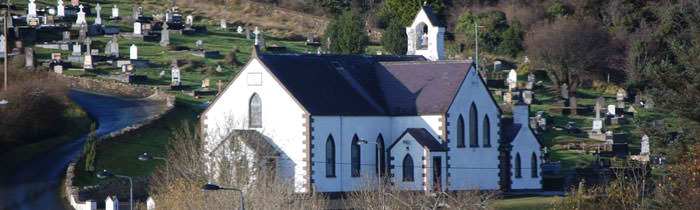
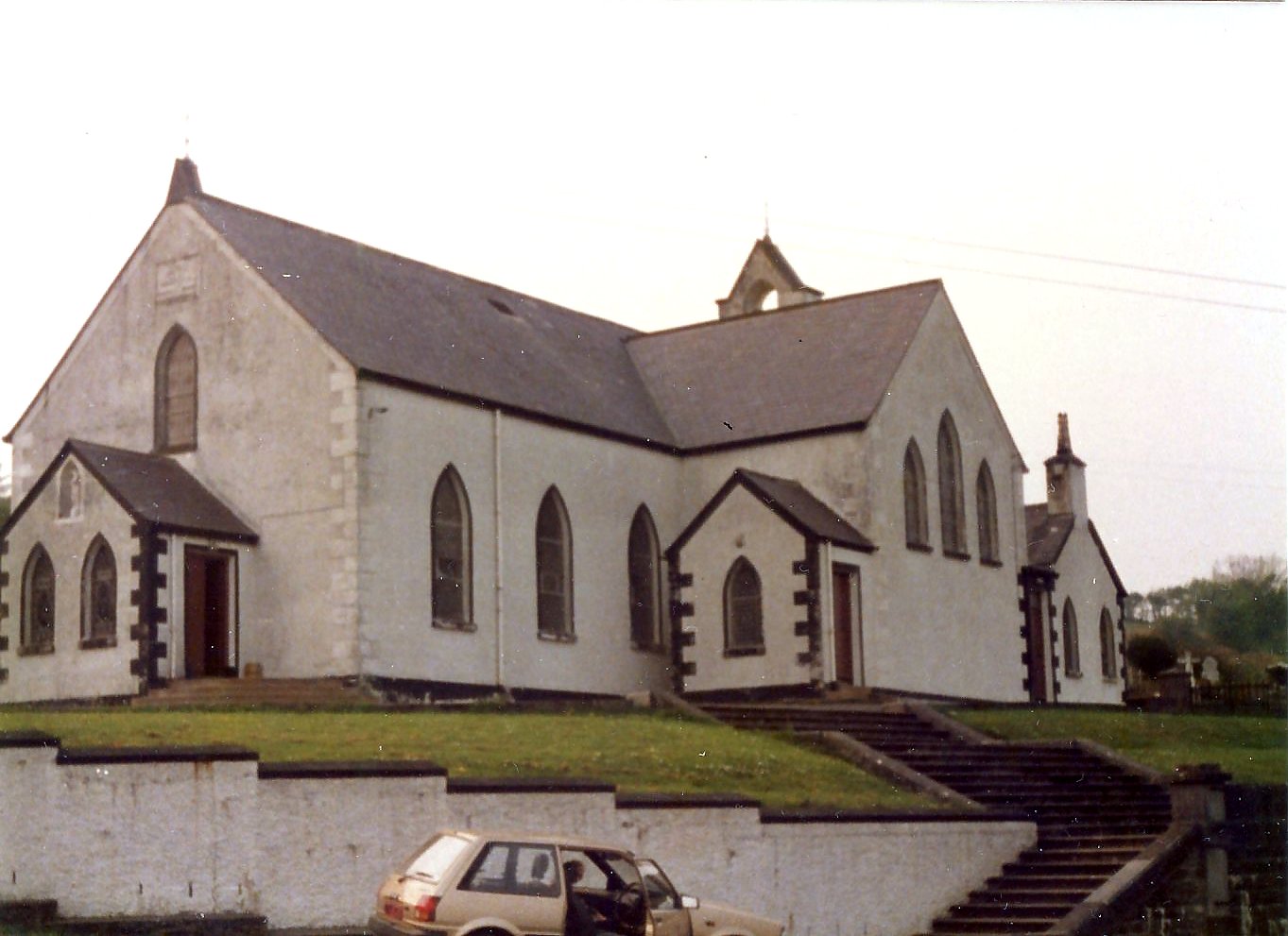
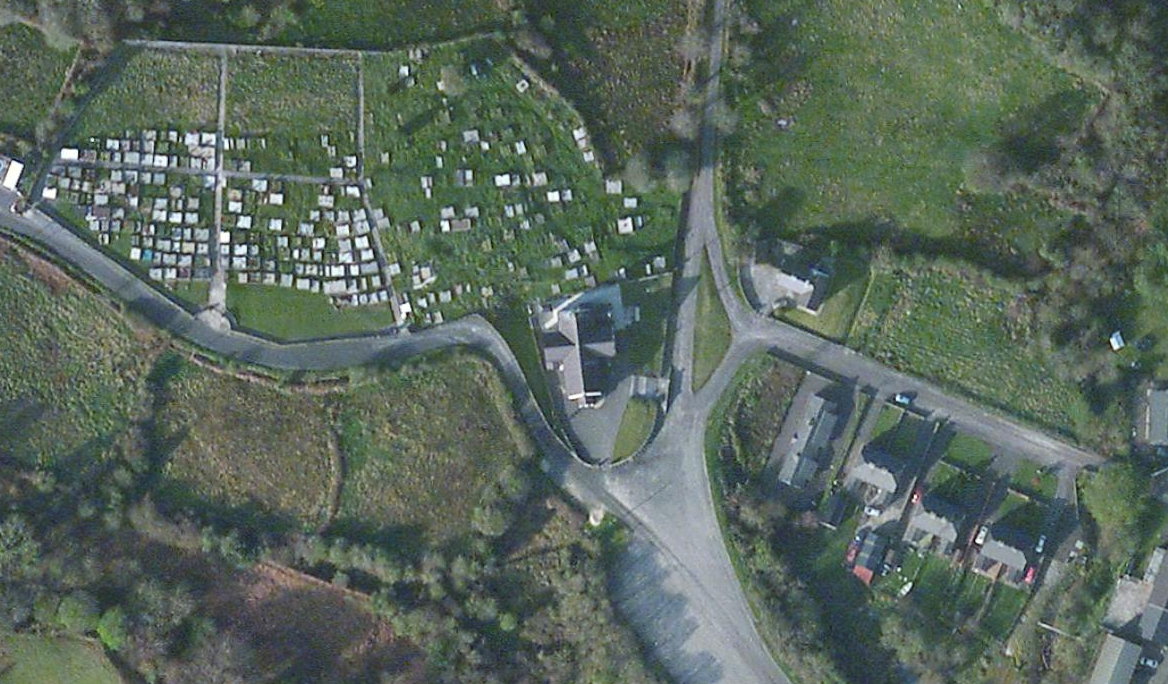
happy day, taking place in Arigna at the Church of The Immaculate Conception of The Blessed Virgin Mary, about
two miles to the North of Keadue in Roscommon, a district renowned for coal and iron mining in the past.
On the site of the church was a building used as a stable for horses. In 1825 it was decided to convert
the site and began the construction of a chapel, the work completed in 1830.
Eliza Quinn‘s father, another of my eight great great grandfathers, is listed as Patrick Quinn ‐ more
about him below in Eliza‘s topic.
‘Full Age’ for James is 28 years old and for his red-headed bride Eliza? Well,
like her daughter Letitia, she does tend to vary her age on paper. Evidence for this on both the 1901 and
1911 census returns and even though she might turn in her grave, I believe she might be "the older woman"
but more about that later.
During our motoring holiday in the 1980s, my Aunt Olive and I did visit Keadue and the Church in Arigna, looking
very much as it does today on the internet and, I suspect, as it did in 1869. I daresay that the occasion
and the austere Church were lightened by the addition of many flowers. We speculated as to how they each
would have travelled from Keadue up to the Chapel and back together, my Aunt saying "by car", and me only
realising for the first time that a "car" was short for "horse and carriage".
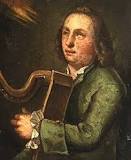
The blind harpist, composer and singer who wandered around Ireland for almost half a century is buried in
the family crypt of his patrons, the McDermott Roes, at the foot of the Arigna Mountains. O'Carolan loved
silly stories, backgammon and drink – his final composition was dedicated to the butler, Flinn, who brought
him his ultimate beverage – but who knows what he would have made of the story of his own skull, which was
removed from the grave a century after his death and, after many adventures, ended up in the National Museum
of Ireland. There’s a song in that, for sure.
Greyfield house was built in the year 1435 by Bishop McDermottroe. the occupants were McDermottroes, O Donnells,
Dolans and the present owner is Patrick Mullhern. Our ancestor Cisley Quinn, was the only other tenant
in the townland of Greyfield, near to and east of Keadue in the 1860s (Griffiths Valuation).
Ionad Cónaithe
Residence at the time of Marriage
Eliza’s Residence on the certificate, ‘Keadue Peyton’, is on the Leitrim Road going towards Drumboylan heading
south-eastwards from Keadue. There is also ‘Keadue Regan’ which is also on the Drumboylan side of Keadue but
just a bit further. The River Furish marks the end
of the Parish so Keadue Peyton and Keadue Regan aren't that far from Keadue.
On the certificate, James’s ‘Residence at the time of his Marriage’ is listed as
‘Belview’. I’m indebted once again to Hughm862 and Peter Mc
of The Royal Irish Constabulary Forum.
Hugh for finding it and Peter for adding further interesting detail and both for their expertise and persistence in
tracking down the location of Belview....
Here, more‐or‐less verbatim is the text of my enquiry in the forum:
Me. Ancestry dot com. I found what is, to me, an interesting record of one my great grandfather
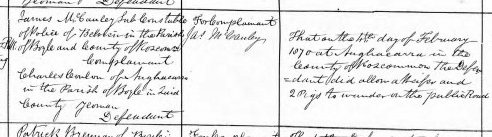
James McCauley's routine tasks as a sub constable in Belview, in the parish of Boyle, in the County of Roscommon
in February 1870..
Can anyone help me with 'Belview', please?
Hughm862 Sorry, but I don't read that as "Belview". Can you cross refer it with other
records for a match? Is it the constables station that is recorded? I had a look at the
Roscommon RIC stations listed and can't match one to the note in the Petty Sessions book.
PeterMc It is poorly written but could indeed be Belview. There was a station there in 1872 of
that name, in Boyle District. Not sure when it was disestablished.
A few entries above refers to Ross, which was a Joint Station at that time with Roscommon police but in Sligo.
Me Thank you. James's marriage registration validates the name "Belview"..
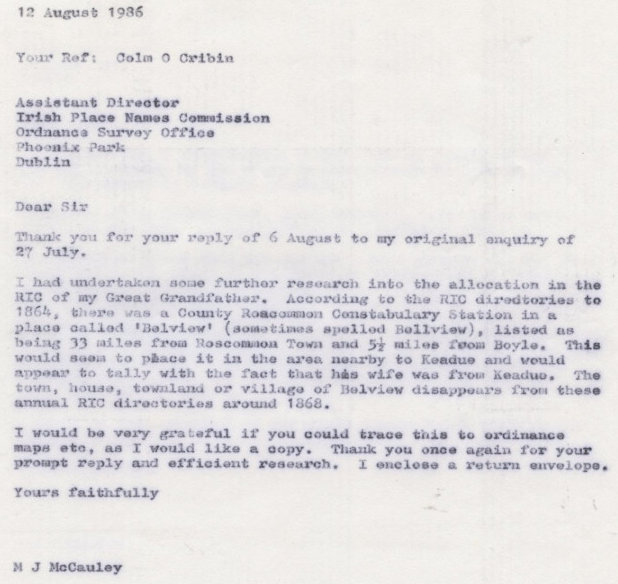
Me Back in August 1986, I wrote to an uncle, and I quote 'Belview Police Station, 5 1/2 Miles north
of Boyle in Roscommon.' How I got to this information I cannot remember but I'll continue looking!
Many thanks.
Hughm862 Let me know if you find it. I'm intrigued (or useless at place finding), I
can't find any trace of a place called Belview in County Roscommon. Must be next‐door
to Brigadoon.
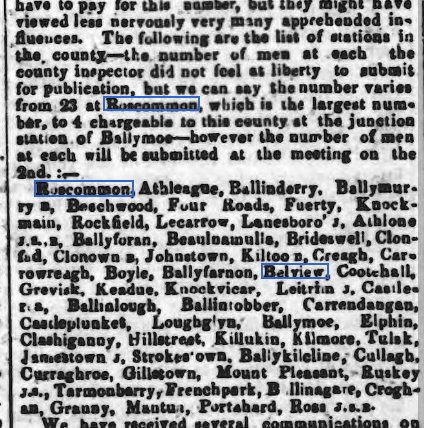
Me ..or Shangri La, Hugh. I found it in a list from the Roscommon Messenger ‐ Saturday 22
September 1860 ..
PeterMc I think the clue may be in the Petty Sessions record. The offence happened in Aughacarra,
or Aghacarra, which is a townland in the Kilbryan Electoral District. Charles Conlon was still living at an
address there in the 1901 Census. James McCaulay must have been stationed fairly near, and there were a few
settlements in that area, along with an RC chapel and Corrigeenroe National School. The whole area is is between
Lough Arrow and Lough Key approx 5 miles north of Boyle. Belview would have been an old name, or anglicisation
of an Irish place name, or name of a large house nearby.
Hughm862 Yes, I agree. I've spent several hours looking on the Griffiths map but still
couldn't find a Belview marked on it. However, many of the settlements don't have names attached.
I even went through street view in the Corrigeenroe, Aghacarra area in case there was a current signpost, but nothing
doing, although Corrigeenroe chapel does have a bell on a metal structure outside. That is not where James was
married however, he was married at Arigna. Would that be the bride's church or does it suggest Belview
was⁄is nearer to Arigna? On a separate matter, I think I may have identified the joint station at
Ross marked on Griffiths, but it is so small I can't be certain. Do you have any idea why Belview is not
listed in the Devia Hibernia?
Me Thanks again for this research, very much appreciated. This morning (morning here in the
Philippines), I went through my correspondence from the 1980s and found this, but I have no further papers or
responses that are relevant for Belview. I think that the directory might have been in the Kew record office
archives as I remember looking through them there. I hope the coordinates might lead closer to the location.
Regards
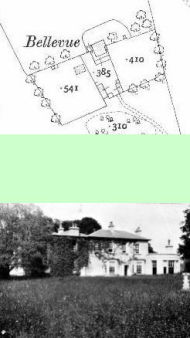
Hughm862 Bingo! I believe I've found it: Bellevue. Townland of Drumdoe, near
Pollnabrock south side of Lough Arrow. Not far from Corrigeenroe. It is marked on Historic Environment
Viewer Cassini 6 inch map. If I can work out how to copy it I'll post it.
https://webgis.archaeology.ie/historicenvironment/
Hughm862 Just found another historic connection to the area near Bellevue: "Drumdoe House, on
the southern shore of Lough Arrow. This house was once part of the Rockingham Estate. Owned by John
Denton French during the War of Independence, he was Lord Lieutenant of Ireland at the time."
PeterMc Well done Hugh! I've located it on the 1888 OSI map (it is on the earlier ones
including Cassini) and copied it here. No notations of any police buildings though, but it must have been
located in, or near, the area highlighted within the rectangle. Perhaps it was orginally a Revenue Police
station, given its location? edit ‐ just seen Hugh's post confirming a police barracks at
Drumdoe (possible under Sgt John Wolfe Flanagan ‐ a John Flanagan served in Roscommon at this time).
The buildings are still there, from Google maps, but a street view reveals nothing ‐ except a fine 'view'
of Lough Arrow a little further along!
By the way, if its not in Devia H then it will be because it was disestablished before that books publication.
So, anyone reading this from Roscommon, some pictures and a little local knowledge is needed from you please.
Hughm862 Hi Peter, the Police Barracks are listed in the valuation roll as 1b. There is a 1b on
the Griffith's map viewer, but it doesn't really add much to the story. Am I correct in reading the
valuation roll as recording John Wolfe Flannigan occupying plots 1, 2 and 3 on the valuation roll? That is over
200 acres. Is that not a lot of land for him to work, in addition to carrying out police duties?
PeterMc He was probably not police in that case – reading around a bit he also went under the name
of John Woulfe Flanagan and if you google around you can find a bit more on him. Also Colonel Lilly, who may
have had some relationship with (or be the same man as) John Scott Lillie (see here). I'll see what more I can find out on the
formation and cessation of Belview.
UPDATE
The earliest I can find it in the RIC Directories is January 1850. It was dis‐established between July 1873
and January 1874 (officially recorded in Directory No.64 for Jan 1874). The last Sergeant there was
Henry Speatman 11376.
At the time James McCauley was a Sub‐Constable there, the Constable (sergeant) would have been
George Montgomery 6042 (until shortly after July 1871) and then Henry Speatman (from Jan
1872 until its closure).
Captain John Woulfe Flanagan J.P., D.L. died Sep 1869 at Drumdoe. Buried in Glasnevin.
Hughm862 The Boston Pilot of 28 December 1850 reported, "The Secretary of the Encumbered Estates
Mr. J. Woulfe Flanagan, is to be High Sheriff of Roscommon." He was certainly High Sheriff of Roscommon
1851'52.
John Woulfe Flanagan (1852'1929), a journalist with The Times was also an interesting character.
The Irish Times has an article on him. Reports his father as Stephen Woulfe Flanagan PC, a judge of the landed
estates court and owner of 3,500 acres in Sligo and Roscommon.
Me Very gratifying for me to have this question solved after 44 years! So happy to have this
information now. Can't thank you enough for your perseverence, Hugh and Peter. Must have a look
in Google Earth to see the countryside.
I'm still downloading the surviving petty sessions court records where my great grandfather James McCauley was
involved ‐ a good way to track his whereabouts. The many many variations in the spelling of
'McCauley' are interesting.
Marriage Register
576 KB (589,824 bytes) 1537 x 2035 pixels 96 dots per inch
James McCauley 1841 ‐ 16th February 1901 - Deaths registered in Killala in the County of Mayo.
James passed away at home in Gore Street, Killala on the 16th February 1901 RIP. Eliza McCauley was present and the
following diagnosis was recorded ‐ "Probably Apoplexy. 10 minutes ‐ No Medical Attendant".
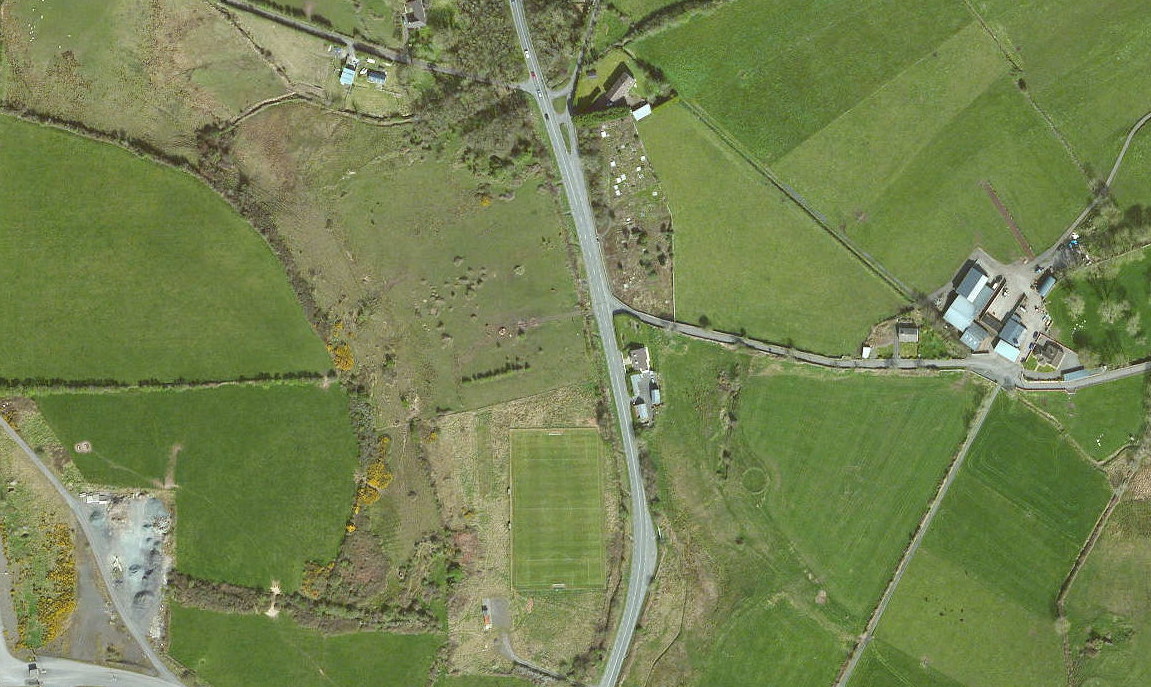
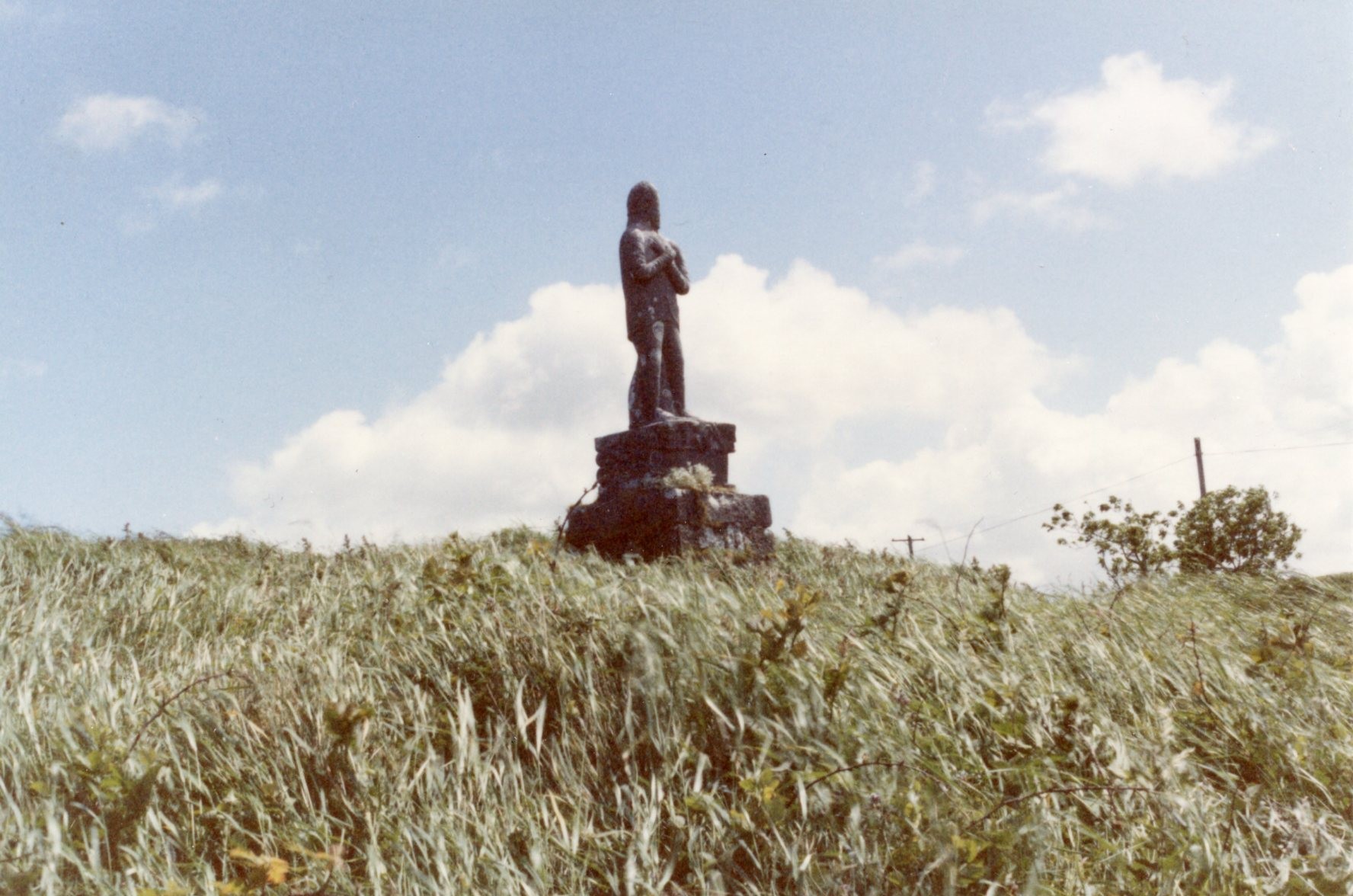
Olive and I stopped off at Crosspatrick Graveyard in the 1980s on the way to Killala. It was a bitterly cold
day and there was an extremely strong breeze. We parked across the road and we opened the gate and walked up
the slope to have a look
for the gravestone for James and Eliza. Olive returned to the car after a few minutes and I persevered in the
search. I gave up after 15 or 20 minutes as my ears were stinging like never before because of the frosty howling
wind. It was only recently that I chanced upon a photograph of the gravestone on line!
The inscription reads:
HAVE MERCY O LORD
ON THE SOUL OF
JAMES McCAULEY
WHO DIED 10TH FEBRUARY 1901
AGED 60 YEARS
Please click to expand:
128 KB (131,072 bytes) 860 x 660 pixels 180 dots per inch
While researching the Petty Sessions Court cases, I found that there were other James McCauleys who'd joined the RIC.
The research has been difficult because, not only are there mis-spellings of our surname by the clerks of the court,
but also there are a substantial number of cases involving these four other James McCauleys:
James McAuley 4275 - also from Fermanagh but 20 years or so older than great grandfather James. His appointment
started in 1841, briefly in Mayo, then Antrim and Belfast, he rose through the ranks to become Head Constable and passed
away after 25years service in 1860 from "Bilious Fever", having received commendations, including the award of a
gold watch.
Jas McCauley 30612 - again, from Fermanagh, only a few years older than great grandfather. He joined in September 1865
at age 22, assigned to Limerick. A brief RIC career, he resigned May 1871 with no noted explanation.
Jas McCauley 38672 - a Draper from Antrim. He joined in May 1872
at age 21, assigned to Tyrone. Another relatively brief RIC career, he was dismissed in April 1879 after several
rather hefty fines throughout. 7 years and 10 months service.
Jas McCauley 64394 - from Donegal, started in the RIC in October 1908 with cases in Donegal, only to resign and join the
Dublin Metropolitan Police in February 1909.
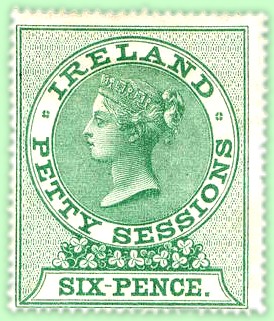
Click on the stamp to view the list of Petty Sessions Court cases
Petty Sessions ‐ Where and When
The first Petty Sessions Court record I've found in which James is the Complainant or Witness, shows him in June 1863,
in Knockvicar, Roscommon. Knockvicar Barracks is now a private house which is immediately on the west
side of Knockvicar Bridge. Kilteasheen townland, mentioned elsewhere
is just over the river Boyle. The
defendant in the case is from the Townland of Crosna, which is across the river Boyle to the north of Knockvicar so
James's first beat must have been fairly extensive.
By June 1866, James is allocated to a barracks in the townland of Grevisk in the Parish of Ardcarna, a few miles west of
Knockvicar. The barracks (as per usual, located close to the "stately home" of a local
landowner) no longer exists.
By the 5th of December 1866, James is working from Boyle.
Three years later in 1869 James was stationed in Belview, Drumdoe ‐ the year he married. At the time that
James McCauley was a Sub‐Constable in Belview, the Constable (sergeant) was George Montgomery
6042 (until shortly after July 1871) and then Henry Speatman (from Jan 1872 until its closure).
George and Henry are logged as Complainants or Witnesses in the same Court record pages as James during this period.
Belview was dis‐established between July 1873 and January 1874 (officially recorded in Directory No.64 for Jan
1874)). The last Sergeant there was Henry Speatman 11376.
James, after marrying Eliza in November 1870, per the RIC rules and regulations, was officially transferred from Belview,
Drumdoe, County Roscommon to County Mayo on 1st July 1870. The following years are those when James's children
‐ my grandfather John and his sister Letitia were born ‐ May 1871 and July 1872 ‐ in Ballaghaderreen,
which was then in County Mayo.
Following a Court appearance on 18th May 1870, there's an eight year gap in James's Petty Court records appearances
until he oddly comes forth at Christmas 1878, as a witness in a Larceny case in Limerick.
Following a gap of five years, later in January 1883, James initiates the Complaint on prosecution in the case of the rape
of one Anne Connor. This case is in the ledgers twice, first via James and then later followed up by the District
Inspector to be brought before a formal hearing at the assizes.
Later in the year ‐ May 1883, several cases are logged where James is stationed in Kilmovee, a village a few miles to
the west of Ballaghaderreen.
At Christmastime 1883, James is logged in the Petty Sessions as a Sergeant in Farmhill, Parish of
Rathrea, County Mayo for the first time in the location. A place of notoriety during the Land War scandals when
the infamous evictors,
Harriet Gardiner and
Susanna Pringle were clearing their lands with the protection and assistance of the RIC. However, in 1883,
Gardiner's uncle George Cuffe had died and Gardiner inherited his estate at Belcarra. She would dedicate the final
9 years of her life to clearing that estate of tenants. It is possible that James was part of the force that
supported the terrible and brutal landlordism of those austere days but giving the benefit of the doubt and since he was
assigned to Farmhill late in 1883, the villainous duo by then had transferred their nefarious activities southwards to
Belcarra estate lands, about 37 miles ‐ 60km distance away from Farmhill, South of Castlebar.
(From Mayo People website)
"There is no doubt but that Gardiner could not have achieved her objectives without the assistance of the RIC who
stood by in considerable numbers and witnessed and facilitated the forced eviction, beating and humiliation of men, women
and children. The communities at Frenchill, Logaphuill, Tully and Elmhall were at the front line of Gardiner's
assault and her actions in these townlands resonated for generations. Gardiner and Pringle ultimately moved from
Farmhill to Tully a few miles from Belcarra and built a cottage there with the stones of demolished cabins. Her
bailiff William Cuffe lived next door in the evicted homestead of the Macken family. While at Tully the RIC
constructed and staffed a hut to protect the pair."
Following several cases of, mostly, Dog License omissions, an interesting case of Estreat Recognizance is
logged in the prosecution of three farmers for defaulting on the conditions in August 1887.
In the final case of Petty Sessions Courts that I've found, logged for 5th June 1889, in which James has a role is
when, while still at Farmhill, he is assaulted by a Tailor of all people, following an interference in an arrest.














































 held the property valued at £20 from the Ecclesiastical Commissioners. In the late 19th century this house
was the home of Captain Alfred Charles Knox, a younger son of John Knox of Castlerea, Killala. Bence Jones writes
that the house was enlarged circa 1820 by the addition of a bow shaped wing and that for a time it was the home of the
Pery Knox Gore family. In the later 19th century the house was the home of the Timony family who owned a
substantial import business in Killala. In the later 20th century owned by Lord Rathcaven and now the Irish home
of Noeleen Farrell.